Ch.12 - Liquids, Solids & Intermolecular Forces
Tro - Chemistry: A Molecular Approach 6th Edition
Tro6th EditionChemistry: A Molecular ApproachISBN: 9780137832217Non è quello che usi tu?Cambia libro di testo
Capitolo 12, Problema 51

Which compound would you expect to have greater surface tension: acetone [(CH3)2CO] or water (H2O)? Explain.

Guida verificata passo dopo passo
1
Identify the intermolecular forces present in each compound. Acetone has dipole-dipole interactions and London dispersion forces, while water has hydrogen bonding, dipole-dipole interactions, and London dispersion forces.
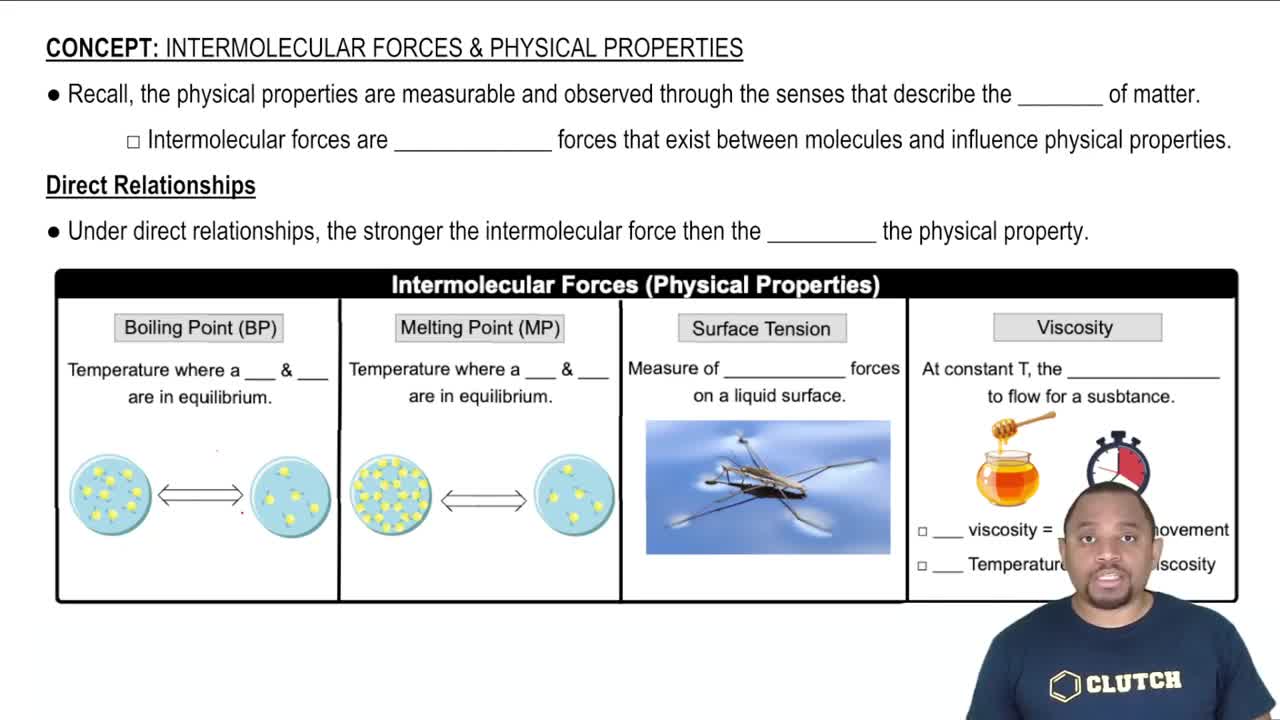
Understand that surface tension is influenced by the strength of intermolecular forces. Stronger intermolecular forces result in higher surface tension.
Recognize that hydrogen bonding is a particularly strong type of intermolecular force, which is present in water but not in acetone.
Compare the overall strength of intermolecular forces in acetone and water. Water's hydrogen bonds make its intermolecular forces stronger than those in acetone.
Conclude that water, with its stronger intermolecular forces due to hydrogen bonding, would have a greater surface tension compared to acetone.

Risposta video verificata per un problema simile:

Questa soluzione video è stata consigliata dai nostri tutor come utile per risolvere questo problema.
Durata del video:
59s

Concetti chiave

Ecco i concetti essenziali che devi comprendere per rispondere correttamente alla domanda.

Surface Tension

Surface tension is a physical property of liquids that describes the elastic-like force at the surface of a liquid. It arises from the cohesive forces between liquid molecules, which are stronger at the surface due to the lack of neighboring molecules above. This phenomenon causes the surface to behave like a stretched elastic membrane, influencing how liquids interact with solids and other liquids.
Video consigliato:
Percorso guidato
03:13
Intermolecular Forces and Properties

Hydrogen Bonding

Hydrogen bonding is a type of strong intermolecular attraction that occurs when hydrogen is covalently bonded to highly electronegative atoms like oxygen or nitrogen. In water (H2O), each molecule can form up to four hydrogen bonds with neighboring molecules, leading to a highly structured network. This strong bonding significantly contributes to water's high surface tension compared to many other liquids.
Video consigliato:
Percorso guidato
01:22
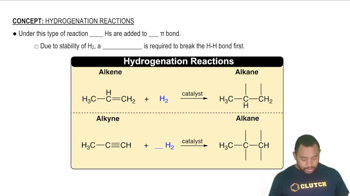
Hydrogenation Reactions

Molecular Structure and Polarity

The molecular structure and polarity of a compound greatly influence its physical properties, including surface tension. Water is a polar molecule, meaning it has a partial positive charge on one side and a partial negative charge on the other, allowing for strong intermolecular attractions. In contrast, acetone [(CH3)2CO] is less polar and has weaker intermolecular forces, resulting in lower surface tension compared to water.
Video consigliato:
Percorso guidato
02:38
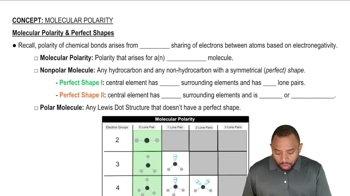
Molecular Polarity