The density of an unknown metal is 12.3 g/cm3, and its atomic radius is 0.134 nm. It has a face-centered cubic lattice. Find the atomic mass of this metal
Ch.13 - Solids & Modern Materials

Tro6th EditionChemistry: A Molecular ApproachISBN: 9780137832217Non è quello che usi tu?Cambia libro di testo
Capitolo 13, Problema 87
An unknown metal is found to have a density of 7.8748 g/cm3 and to crystallize in a body-centered cubic lattice. The edge of the unit cell is 0.28664 nm. Calculate the atomic mass of the metal.
Guida verificata passo dopo passo1
Convert the edge length of the unit cell from nanometers to centimeters by using the conversion factor: 1 nm = 1 x 10^{-7} cm.
Calculate the volume of the unit cell using the formula for the volume of a cube: V = a^3, where 'a' is the edge length in centimeters.
Determine the mass of the unit cell by multiplying the volume of the unit cell by the density of the metal: mass = density x volume.
In a body-centered cubic (BCC) lattice, there are 2 atoms per unit cell. Use this information to find the mass of a single atom by dividing the mass of the unit cell by 2.
Calculate the atomic mass of the metal by converting the mass of a single atom from grams to atomic mass units (amu) using the conversion factor: 1 amu = 1.66053906660 x 10^{-24} g.

Risposta video verificata per un problema simile:
Questa soluzione video è stata consigliata dai nostri tutor come utile per risolvere questo problema.
Concetti chiave
Ecco i concetti essenziali che devi comprendere per rispondere correttamente alla domanda.
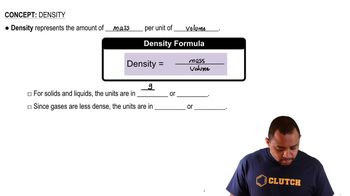
Density and its Calculation
Density is defined as mass per unit volume, typically expressed in grams per cubic centimeter (g/cm³). To calculate the density of a substance, one can use the formula: density = mass/volume. In this context, knowing the density of the metal allows us to relate it to the atomic mass and the volume of the unit cell.
Video consigliato:
Percorso guidato
Density Concepts
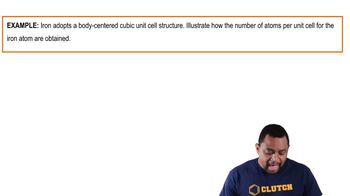
Body-Centered Cubic (BCC) Lattice
A body-centered cubic lattice is a type of crystal structure where atoms are located at each corner of a cube and one atom is positioned at the center of the cube. This arrangement affects the packing efficiency and the volume occupied by the atoms, which is crucial for calculating the atomic mass based on the unit cell dimensions.
Video consigliato:
Percorso guidato
Body Centered Cubic Example
Unit Cell Volume and Atomic Mass Relationship
The volume of a unit cell can be calculated using the edge length of the cube, raised to the third power (V = a³). In a BCC structure, there are two atoms per unit cell, and the relationship between the mass of the atoms, the density, and the volume of the unit cell can be used to derive the atomic mass of the metal using the formula: atomic mass = (density × unit cell volume) / number of atoms per unit cell.
Video consigliato:
Percorso guidato
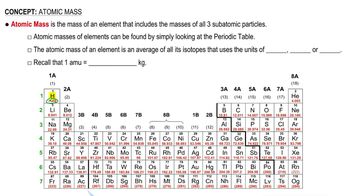
Atomic Mass
Pratica correlata
Domanda del libro di testo
2320
views
Domanda del libro di testo
Copper iodide crystallizes in the zinc blende structure. The sep- aration between nearest neighbor cations and anions is approximately 311 pm, and the melting point is 606 °C. Potassium chloride, by contrast, crystallizes in the rock salt structure. Even though the separation between nearest-neighbor cations and anions is greater (319 pm), the melting point of potassium chlo- ride is higher (776 °C). Explain.
472
views
Domanda del libro di testo
X-ray diffractometers often use metals that have had their core electrons excited as a source of X-rays. Consider the 2p → 1s transition for copper, which is called the K⍺ transition. Calculate the wavelength of X-rays (in Å) given off by the K⍺ transition if the energy given off by a mole of copper atoms is 7.77⨉105 kJ.(1Å = 10-10 m)
303
views