
A 100.0-mL aqueous sodium chloride solution is 13.5% NaCl by mass and has a density of 1.12 g/mL. What would you add (solute or solvent) and what mass of it to make the boiling point of the solution 104.4 °C? (Use i = 1.8 for NaCl.)
Ch.14 - Solutions

Tro6th EditionChemistry: A Molecular ApproachISBN: 9780137832217Non è quello che usi tu?Cambia libro di testo
Capitolo 14, Problema 132
A 50.0-mL solution is initially 1.55% MgCl2 by mass and has a density of 1.05 g/mL. What is the freezing point of the solution after you add an additional 1.35 g MgCl2? (Use i = 2.5 for MgCl2.)
Guida verificata passo dopo passo1
Calculate the initial mass of the solution using its volume and density: \( \text{mass} = \text{volume} \times \text{density} \).
Determine the initial mass of MgCl_2 in the solution using the percentage by mass: \( \text{mass of MgCl}_2 = \text{total mass} \times \frac{1.55}{100} \).
Add the additional 1.35 g of MgCl_2 to the initial mass of MgCl_2 to find the total mass of MgCl_2 in the solution.
Calculate the molality of the solution: \( \text{molality} = \frac{\text{moles of solute}}{\text{kilograms of solvent}} \). First, find moles of MgCl_2 using its molar mass, then find the mass of the solvent by subtracting the mass of MgCl_2 from the total mass of the solution.
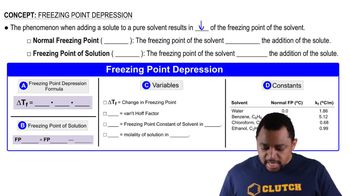
Use the freezing point depression formula: \( \Delta T_f = i \cdot K_f \cdot m \), where \( i \) is the van't Hoff factor, \( K_f \) is the freezing point depression constant for water, and \( m \) is the molality, to find the change in freezing point. Subtract \( \Delta T_f \) from the normal freezing point of water to find the new freezing point.

Risposta video verificata per un problema simile:
Questa soluzione video è stata consigliata dai nostri tutor come utile per risolvere questo problema.
Durata del video:
6mConcetti chiave
Ecco i concetti essenziali che devi comprendere per rispondere correttamente alla domanda.
Colligative Properties
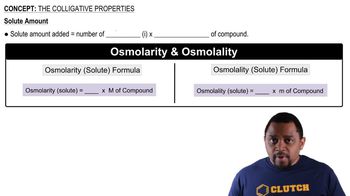
Colligative properties are physical properties of solutions that depend on the number of solute particles in a given amount of solvent, rather than the identity of the solute. These properties include boiling point elevation, freezing point depression, vapor pressure lowering, and osmotic pressure. In this question, the freezing point depression is relevant as it quantifies how the addition of solute affects the freezing point of the solution.
Video consigliato:
Percorso guidato
Colligative Properties
Freezing Point Depression
Freezing point depression is a colligative property that describes the decrease in the freezing point of a solvent when a solute is added. The extent of freezing point depression can be calculated using the formula ΔTf = i * Kf * m, where ΔTf is the change in freezing point, i is the van 't Hoff factor (number of particles the solute dissociates into), Kf is the freezing point depression constant of the solvent, and m is the molality of the solution.
Video consigliato:
Percorso guidato
Freezing Point Depression
Van 't Hoff Factor (i)
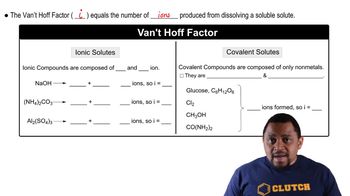
The van 't Hoff factor (i) is a dimensionless number that indicates the number of particles into which a solute dissociates in solution. For ionic compounds like MgCl2, which dissociates into one Mg²⁺ ion and two Cl⁻ ions, the van 't Hoff factor is 2.5 in this case, accounting for the degree of ionization and any association that may occur in solution, which is crucial for accurately calculating colligative properties.
Video consigliato:
Percorso guidato
Van't Hoff Factor
Pratica correlata
Domanda del libro di testo
1922
views
1
comments
Domanda del libro di testo
The osmotic pressure of a solution containing 2.10 g of an unknown compound dissolved in 175.0 mL of solution at 25 °C is 1.93 atm. The combustion of 24.02 g of the unknown compound produced 28.16 g CO2 and 8.64 g H2O. What is the molecular formula of the compound (which contains only carbon, hydrogen, and oxygen)?
1762
views
Domanda del libro di testo
A solution contains 10.05 g of unknown compound dissolved in 50.0 mL of water. (Assume a density of 1.00 g/mL for water.) The freezing point of the solution is -3.16 °C. The mass percent composition of the compound is 60.97% C, 11.94% H, and the rest is O. What is the molecular formula of the compound?
1442
views
