
Ch.14 - Solutions
Tro - Chemistry: A Molecular Approach 6th Edition
Tro6th EditionChemistry: A Molecular ApproachISBN: 9780137832217Non è quello che usi tu?Cambia libro di testo
Capitolo 14, Problema 77

Calculate the vapor pressure of a solution containing 38.3 g of glycerin (C3H8O3) in 135 mL of water at 30.0 °C. The vapor pressure of pure water at this temperature is 31.8 torr. Assume that glycerin is not volatile and dissolves molecularly (i.e., it is not ionic), and use a density of 1.00 g>mL for the water.

Guida verificata passo dopo passo
1
Calculate the moles of glycerin (C_3H_8O_3) using its molar mass.
Calculate the mass of water using its density and volume, then convert this mass to moles using the molar mass of water.
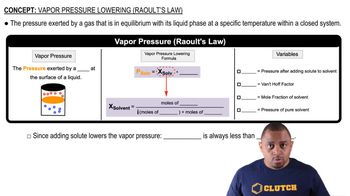
Use Raoult's Law to find the vapor pressure of the solution: P_solution = X_solvent * P_pure solvent, where X_solvent is the mole fraction of the solvent (water).
Calculate the mole fraction of water (X_solvent) by dividing the moles of water by the total moles of the solution (moles of water + moles of glycerin).
Substitute the mole fraction of water and the vapor pressure of pure water into Raoult's Law to find the vapor pressure of the solution.

Risposta video verificata per un problema simile:

Questa soluzione video è stata consigliata dai nostri tutor come utile per risolvere questo problema.
Durata del video:
4m

Concetti chiave

Ecco i concetti essenziali che devi comprendere per rispondere correttamente alla domanda.

Vapor Pressure

Vapor pressure is the pressure exerted by a vapor in equilibrium with its liquid or solid form at a given temperature. It reflects the tendency of particles to escape from the liquid phase into the vapor phase. In solutions, the presence of a non-volatile solute, like glycerin, lowers the vapor pressure of the solvent compared to that of the pure solvent.
Video consigliato:
Percorso guidato
02:40
Raoult's Law and Vapor Pressure

Raoult's Law

Raoult's Law states that the vapor pressure of a solvent in a solution is directly proportional to the mole fraction of the solvent in the solution. This law is crucial for calculating the vapor pressure of a solution when a non-volatile solute is present. It helps in determining how the addition of solute affects the overall vapor pressure of the solvent.
Video consigliato:
Percorso guidato
02:40
Raoult's Law and Vapor Pressure

Mole Fraction

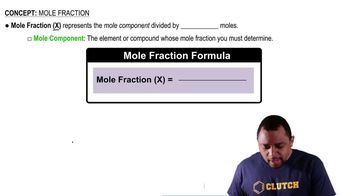
Mole fraction is a way of expressing the concentration of a component in a mixture, defined as the number of moles of that component divided by the total number of moles of all components in the mixture. In this context, calculating the mole fraction of water in the solution is essential for applying Raoult's Law to find the vapor pressure of the solution.
Video consigliato:
Percorso guidato
00:36
Mole Fraction Formula