
Ch.14 - Solutions
Tro - Chemistry: A Molecular Approach 6th Edition
Tro6th EditionChemistry: A Molecular ApproachISBN: 9780137832217Non è quello che usi tu?Cambia libro di testo
Capitolo 14, Problema 113

The Safe Drinking Water Act (SDWA) sets a limit for mercury—a toxin to the central nervous system—at 0.0020 ppm by mass. Water suppliers must periodically test their water to ensure that mercury levels do not exceed this limit. Suppose water becomes contaminated with mercury at twice the legal limit (0.0040 ppm). How much of this water would a person have to consume to ingest 50.0 mg of mercury?

Guida verificata passo dopo passo
1
Determine the concentration of mercury in the water in terms of mg/L. Since 1 ppm is equivalent to 1 mg/L, the concentration of mercury in the contaminated water is 0.0040 mg/L.
Set up the equation to find the volume of water needed to ingest 50.0 mg of mercury. Use the formula: \( \text{Mass of mercury} = \text{Concentration of mercury} \times \text{Volume of water} \).
Rearrange the equation to solve for the volume of water: \( \text{Volume of water} = \frac{\text{Mass of mercury}}{\text{Concentration of mercury}} \).
Substitute the known values into the equation: \( \text{Volume of water} = \frac{50.0 \, \text{mg}}{0.0040 \, \text{mg/L}} \).
Calculate the volume of water needed to ingest 50.0 mg of mercury, ensuring to keep track of units and converting them if necessary to more understandable units like liters or gallons.

Risposta video verificata per un problema simile:

Questa soluzione video è stata consigliata dai nostri tutor come utile per risolvere questo problema.
Durata del video:
1m

Concetti chiave

Ecco i concetti essenziali che devi comprendere per rispondere correttamente alla domanda.

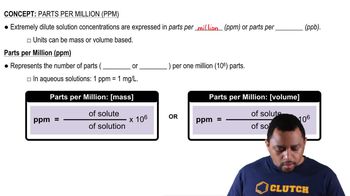
Parts Per Million (ppm)

Parts per million (ppm) is a unit of measurement used to describe the concentration of a substance in a solution. It indicates how many parts of a substance are present in one million parts of the total solution. For example, a concentration of 0.0020 ppm means that there are 0.0020 grams of mercury in one million grams of water, which is crucial for understanding contamination levels in drinking water.
Video consigliato:
Percorso guidato
01:38
Parts per Million (ppm)

Mass and Volume Relationships

Understanding the relationship between mass and volume is essential for solving problems involving concentrations. In this context, knowing the density of water allows us to convert between mass (in mg) and volume (in liters or milliliters). This relationship helps determine how much contaminated water a person would need to consume to reach a specific mass of mercury.
Video consigliato:
Percorso guidato
01:09
Relationship of Volume and Moles Example

Toxicology and Safe Exposure Levels

Toxicology is the study of the effects of chemicals on living organisms, including the assessment of safe exposure levels. The Safe Drinking Water Act establishes limits for contaminants like mercury to protect public health. Understanding these limits is vital for evaluating the risks associated with consuming contaminated water and determining how much water would lead to harmful exposure.
Video consigliato:
Percorso guidato
01:59
Catalyzed vs. Uncatalyzed Reactions
Pratica correlata
Domanda del libro di testo

Water softeners often replace calcium ions in hard water with sodium ions. Since sodium compounds are soluble, the presence of sodium ions in water does not cause the white, scaly residues caused by calcium ions. However, calcium is more beneficial to human health than sodium because calcium is a necessary part of the human diet, while high levels of sodium intake are linked to increases in blood pressure. The U.S. Food and Drug Administration (FDA) recommends that adults ingest less than 2.4 g of sodium per day. How many liters of softened water, containing a sodium concentration of 0.050% sodium by mass, would a person have to consume to exceed the FDA recommendation? (Assume a water density of 1.0 g/mL.)

1517
views
Domanda del libro di testo

A gas has a Henry's law constant of 0.112 M>atm. What total volume of solution is needed to completely dissolve 1.65 L of the gas at a pressure of 725 torr and a temperature of 25 °C?

2238
views
3
rank
Domanda del libro di testo

A saturated solution forms when 0.0537 L of argon, at a pressure of 1.0 atm and temperature of 25 °C, is dissolved in 1.0 L of water. Calculate the Henry's law constant for argon.

1603
views
1
comments
Domanda del libro di testo

Sodium hydroxide (NaOH) has a lattice energy of -887 kJ/mol and a heat of hydration of -932 kJ/mol. How much solution could be heated to boiling by the heat evolved by the dissolution of 25.0 g of NaOH? (For the solution, assume a heat capacity of 4.0 J/g·°C, an initial temperature of 25.0 °C, a boiling point of 100.0 °C, and a density of 1.05 g/mL.)

1773
views