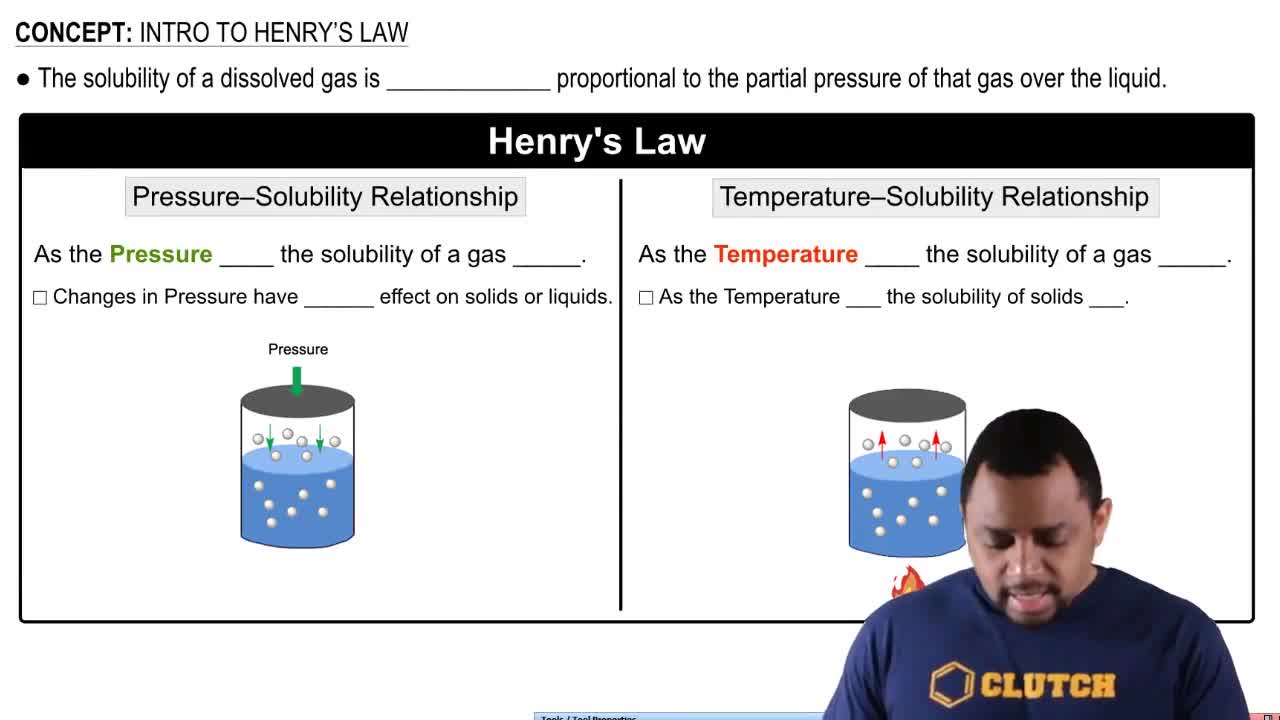
A saturated solution forms when 0.0537 L of argon, at a pressure of 1.0 atm and temperature of 25 °C, is dissolved in 1.0 L of water. Calculate the Henry's law constant for argon.
Ch.14 - Solutions

Tro6th EditionChemistry: A Molecular ApproachISBN: 9780137832217Non è quello che usi tu?Cambia libro di testo
Capitolo 14, Problema 107
The solubility of carbon tetrachloride (CCl4) in water at 25 °C is 1.2 g/L. The solubility of chloroform (CHCl3) at the same temperature is 10.1 g/L. Why is chloroform almost ten times more soluble in water than carbon tetrachloride?
Guida verificata passo dopo passo1
Understand the molecular structures of carbon tetrachloride (CCl4) and chloroform (CHCl3). Carbon tetrachloride has four chlorine atoms symmetrically attached to a central carbon atom, making it a nonpolar molecule. Chloroform has three chlorine atoms and one hydrogen atom attached to the central carbon, giving it a slight polarity due to the difference in electronegativity between carbon and hydrogen.
Recognize the principle 'like dissolves like' in solubility. Polar substances tend to dissolve well in polar solvents, and nonpolar substances dissolve better in nonpolar solvents. Water is a polar solvent.
Analyze the polarity of chloroform compared to carbon tetrachloride. The presence of the hydrogen atom in chloroform introduces a dipole moment (a separation of electric charge leading to a molecule having a partial positive end and a partial negative end), which is absent in carbon tetrachloride.
Consider the hydrogen bonding potential in chloroform. The hydrogen atom in chloroform can participate in hydrogen bonding with water molecules, which enhances its solubility in water.
Conclude that the increased solubility of chloroform in water compared to carbon tetrachloride is due to its slight polarity and ability to form hydrogen bonds with water, unlike carbon tetrachloride which is completely nonpolar and lacks this capability.

Risposta video verificata per un problema simile:
Questa soluzione video è stata consigliata dai nostri tutor come utile per risolvere questo problema.
Durata del video:
2mConcetti chiave
Ecco i concetti essenziali che devi comprendere per rispondere correttamente alla domanda.
Polarity
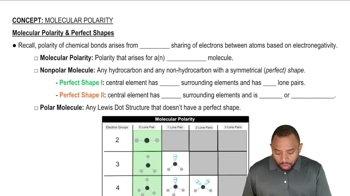
Polarity refers to the distribution of electrical charge over the atoms in a molecule. Polar molecules, like water, have a significant difference in electronegativity between their atoms, leading to partial positive and negative charges. In contrast, carbon tetrachloride (CCl4) is a nonpolar molecule due to its symmetrical tetrahedral shape, which prevents any dipole moment. This difference in polarity affects solubility, as polar solvents dissolve polar solutes more effectively.
Video consigliato:
Percorso guidato
Molecular Polarity
Hydrogen Bonding
Hydrogen bonding is a strong type of dipole-dipole interaction that occurs when hydrogen is bonded to highly electronegative atoms like oxygen, nitrogen, or fluorine. Chloroform (CHCl3) can engage in hydrogen bonding with water due to its polar C-H and C-Cl bonds, allowing it to mix more readily with water. In contrast, carbon tetrachloride lacks the ability to form hydrogen bonds, resulting in its lower solubility in water.
Video consigliato:
Percorso guidato
Hydrogenation Reactions
Like Dissolves Like
The principle of 'like dissolves like' states that polar solvents tend to dissolve polar solutes, while nonpolar solvents dissolve nonpolar solutes. Since water is a polar solvent, it is more effective at dissolving polar substances. Chloroform, being more polar than carbon tetrachloride, aligns better with water's polarity, leading to its higher solubility. This concept is fundamental in predicting solubility behaviors in various chemical systems.
Video consigliato:
Percorso guidato
Henry's Law Solubility
Pratica correlata
Domanda del libro di testo
1603
views
1
comments
Domanda del libro di testo
An aqueous CaCl2 solution has a vapor pressure of 81.6 mmHg at 50 °C. The vapor pressure of pure water at this temperature is 92.6 mmHg. What is the concentration of CaCl2 in mass percent? (Assume complete dissociation of the solute.)
2270
views
1
comments
Domanda del libro di testo
Calculate the vapor pressure at 25 °C of an aqueous solution that is 5.50% NaCl by mass. (Assume complete dissociation of the solute.)
2287
views
Domanda del libro di testo
Sodium hydroxide (NaOH) has a lattice energy of -887 kJ/mol and a heat of hydration of -932 kJ/mol. How much solution could be heated to boiling by the heat evolved by the dissolution of 25.0 g of NaOH? (For the solution, assume a heat capacity of 4.0 J/g·°C, an initial temperature of 25.0 °C, a boiling point of 100.0 °C, and a density of 1.05 g/mL.)
1773
views