Use the van't Hoff factors in Table 13.9 to calculate each colligative property: a. the melting point of a 0.100 m iron(III) chloride solution
Ch.14 - Solutions

Tro6th EditionChemistry: A Molecular ApproachISBN: 9780137832217Non è quello che usi tu?Cambia libro di testo
Capitolo 14, Problema 95
What mass of salt (NaCl) should you add to 1.00 L of water in an ice cream maker to make a solution that freezes at -10.0 °C? Assume complete dissociation of the NaCl and density of 1.00 g/mL for water.
Guida verificata passo dopo passo1
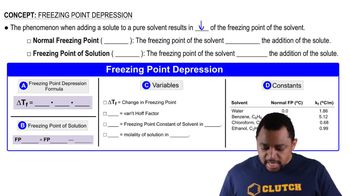
Identify the formula for freezing point depression: \( \Delta T_f = i \cdot K_f \cdot m \), where \( \Delta T_f \) is the change in freezing point, \( i \) is the van't Hoff factor, \( K_f \) is the cryoscopic constant, and \( m \) is the molality.
Determine the change in freezing point: \( \Delta T_f = 0.0 \text{ °C} - (-10.0 \text{ °C}) = 10.0 \text{ °C} \).
For NaCl, the van't Hoff factor \( i \) is 2 because it dissociates into two ions: Na\(^+\) and Cl\(^-\).
Use the known value of \( K_f \) for water, which is 1.86 \(\text{ °C kg/mol}\). Substitute the values into the formula: \( 10.0 = 2 \cdot 1.86 \cdot m \) to solve for molality \( m \).
Convert molality to mass: Use the definition of molality \( m = \frac{\text{moles of solute}}{\text{kg of solvent}} \) and the molar mass of NaCl (58.44 g/mol) to find the mass of NaCl needed.

Risposta video verificata per un problema simile:
Questa soluzione video è stata consigliata dai nostri tutor come utile per risolvere questo problema.
Concetti chiave
Ecco i concetti essenziali che devi comprendere per rispondere correttamente alla domanda.
Freezing Point Depression
Freezing point depression is a colligative property that describes how the freezing point of a solvent decreases when a solute is added. The extent of this depression depends on the number of solute particles in the solution, not their identity. For ionic compounds like NaCl, which dissociates into two ions (Na+ and Cl-), the effect is doubled, making it crucial for calculating the required mass of solute to achieve a desired freezing point.
Video consigliato:
Percorso guidato
Freezing Point Depression
Colligative Properties
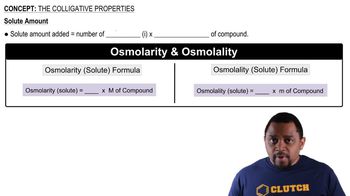
Colligative properties are properties of solutions that depend on the ratio of solute particles to solvent molecules, rather than the type of solute. These properties include boiling point elevation, freezing point depression, vapor pressure lowering, and osmotic pressure. Understanding these properties is essential for determining how much solute to add to achieve specific physical changes in the solvent, such as lowering the freezing point of water.
Video consigliato:
Percorso guidato
Colligative Properties
Molarity and Density
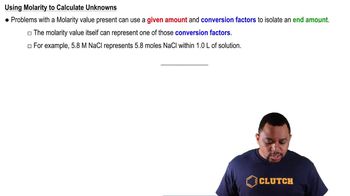
Molarity is a measure of concentration defined as the number of moles of solute per liter of solution. In this context, knowing the density of water (1.00 g/mL) allows for the conversion between volume and mass, which is necessary for calculating how much NaCl to add. Since the problem involves a specific volume of water, understanding how to relate mass, volume, and molarity is key to solving the question.
Video consigliato:
Percorso guidato
Molarity
Pratica correlata
Domanda del libro di testo
1654
views
1
rank
Domanda del libro di testo
A 0.100 M ionic solution has an osmotic pressure of 8.3 atm at 25 °C. Calculate the van't Hoff factor (i) for this solution.
1871
views
Domanda del libro di testo
Calculate the freezing point and boiling point of each aqueous solution, assuming complete dissociation of the solute. c. 5.5% NaNO3 by mass (in water)
2335
views
Domanda del libro di testo
A 1.2 m aqueous solution of an ionic compound with the formula MX2 has a boiling point of 101.4 °C. Calculate the van't Hoff factor (i) for MX2 at this concentration.
1529
views
Domanda del libro di testo
Calculate the freezing point and boiling point of each aqueous solution, assuming complete dissociation of the solute. a. 0.100 m K2S b. 21.5 g of CuCl2 in 4.50⨉102 g water
1430
views