Consider the reaction: 2 N2O( g) → 2 N2(g) + O2(g) a. Express the rate of the reaction in terms of the change in concentration of each of the reactants and products.
Ch.15 - Chemical Kinetics

Tro6th EditionChemistry: A Molecular ApproachISBN: 9780137832217Non è quello che usi tu?Cambia libro di testo
Capitolo 15, Problema 27c
Consider the reaction:
2 HBr (g) → H2 (g) + Br2 (g)
c. If the volume of the reaction vessel in part b was 1.25 L, what amount of Br2 (in moles) was formed during the first 15.0 s of the reaction?
Guida verificata passo dopo passo1
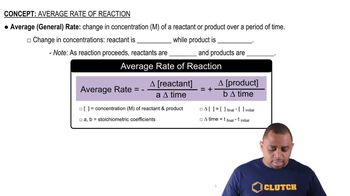
Determine the rate of formation of Br_2 from the given reaction. The rate of formation of Br_2 is equal to the rate of disappearance of HBr divided by 2, based on the stoichiometry of the reaction.
Use the rate of disappearance of HBr to find the rate of formation of Br_2. If the rate of disappearance of HBr is given or can be calculated, divide it by 2 to find the rate of formation of Br_2.
Calculate the amount of Br_2 formed using the rate of formation and the time period. Multiply the rate of formation of Br_2 by the time (15.0 s) to find the amount of Br_2 formed in moles.
Consider the volume of the reaction vessel. Since the volume is given as 1.25 L, ensure that the rate of formation is consistent with this volume, if necessary.
Verify the units and ensure that the final amount of Br_2 is expressed in moles, as required by the problem.

Risposta video verificata per un problema simile:
Questa soluzione video è stata consigliata dai nostri tutor come utile per risolvere questo problema.
Durata del video:
5mConcetti chiave
Ecco i concetti essenziali che devi comprendere per rispondere correttamente alla domanda.
Stoichiometry
Stoichiometry is the calculation of reactants and products in chemical reactions based on the balanced chemical equation. It allows us to determine the relationships between the quantities of substances involved in a reaction. In this case, the stoichiometric coefficients indicate that 2 moles of HBr produce 1 mole of Br2, which is essential for calculating the amount of Br2 formed.
Video consigliato:
Percorso guidato
Stoichiometry Concept
Ideal Gas Law
The Ideal Gas Law relates the pressure, volume, temperature, and number of moles of a gas through the equation PV = nRT. This law is crucial for understanding how gases behave under different conditions. In this question, knowing the volume of the reaction vessel (1.25 L) allows us to calculate the number of moles of Br2 produced using the ideal gas law, assuming standard conditions.
Video consigliato:
Percorso guidato
Ideal Gas Law Formula
Reaction Rate
Reaction rate refers to the speed at which reactants are converted into products in a chemical reaction. It can be influenced by factors such as concentration, temperature, and the presence of catalysts. In this scenario, understanding the time frame (15.0 s) is important for determining how much Br2 is formed during that period, which can be calculated using the reaction rate and stoichiometry.
Video consigliato:
Percorso guidato
Average Rate of Reaction
Pratica correlata
Domanda del libro di testo
3067
views
Domanda del libro di testo
Consider the reaction:
2 HBr (g) → H2 (g) + Br2 (g)
a. Express the rate of the reaction in terms of the change in concentration of each of the reactants and products.
1716
views
1
rank
Domanda del libro di testo
Consider the reaction:
2 HBr (g) → H2 (g) + Br2 (g)
b. In the first 20.0 s of this reaction, the concentration of HBr dropped from 0.600 M to 0.512 M. Calculate the average rate of the reaction during this time interval.
1
views
Domanda del libro di testo
For the reaction 2 A(gg) + B(g) → 3 C(g), b. when A is decreasing at a rate of 0.200 M/s, how fast is B decreasing? How fast is C increasing?
1
views
Domanda del libro di testo
For the reaction 2 A(g) + B(g) → 3 C(g), a. Determine the expression for the rate of the reaction in terms of the change in concentration of each of the reactants and products.
2263
views
3
rank