
Iodine atoms combine to form I2 in liquid hexane solvent with a rate constant of 1.5⨉1010 L/mols. The reaction is second order in I. Since the reaction occurs so quickly, the only way to study the reaction is to create iodine atoms almost instantaneously, usually by photochemical decomposition of I2. Suppose a flash of light creates an initial [I] concentration of 0.0100 M. How long will it take for 95% of the newly created iodine atoms to recombine to form I2?
Ch.15 - Chemical Kinetics

Tro6th EditionChemistry: A Molecular ApproachISBN: 9780137832217Non è quello che usi tu?Cambia libro di testo
Capitolo 15, Problema 101a
Consider this energy diagram:
a. How many elementary steps are involved in this reaction?
Guida verificata passo dopo passo1
Identify the number of peaks in the energy diagram. Each peak represents a transition state, which corresponds to an elementary step.
Count the number of valleys or intermediates between the peaks. These valleys represent the intermediates formed during the reaction.
The number of elementary steps is equal to the number of peaks in the energy diagram.
Verify that each peak corresponds to a distinct transition state, indicating a separate elementary step.
Summarize the total number of elementary steps based on the number of peaks identified in the energy diagram.

Risposta video verificata per un problema simile:
Questa soluzione video è stata consigliata dai nostri tutor come utile per risolvere questo problema.
Durata del video:
1mConcetti chiave
Ecco i concetti essenziali che devi comprendere per rispondere correttamente alla domanda.
Elementary Steps
Elementary steps are the individual reactions that occur in a multi-step chemical reaction. Each step represents a single molecular event, such as the collision of reactants leading to products. Understanding the number of elementary steps is crucial for analyzing reaction mechanisms and determining the overall rate of the reaction.
Video consigliato:
Percorso guidato
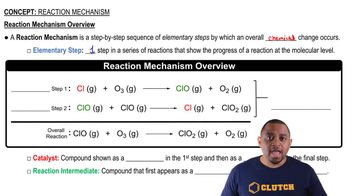
Reaction Mechanism Overview
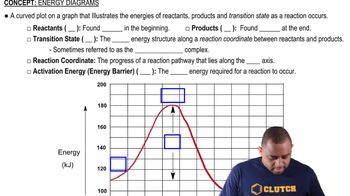
Energy Diagram
An energy diagram visually represents the energy changes that occur during a chemical reaction. It typically shows the energy of reactants, products, and the transition states, indicating the activation energy required for the reaction to proceed. By examining the diagram, one can identify the number of steps and the energy barriers involved in the reaction.
Video consigliato:
Percorso guidato
Energy Diagrams
Reaction Mechanism
A reaction mechanism is a detailed description of the step-by-step process by which reactants are converted into products. It includes the sequence of elementary steps, intermediates formed, and the transition states. Understanding the mechanism is essential for predicting reaction rates and the influence of various factors on the reaction.
Video consigliato:
Percorso guidato
Reaction Mechanism Overview
Pratica correlata
Domanda del libro di testo
2152
views
Domanda del libro di testo
Consider this energy diagram:
d. Is the overall reaction endothermic or exothermic?
949
views
Domanda del libro di testo
Consider the reaction in which HCl adds across the double bond of ethene: HCl + H2C=CH2 → H3C-CH2Cl The following mechanism, with the accompanying energy diagram, has been suggested for this reaction:
Step 1 HCl + H2C=CH2 → H3C=CH2+ + Cl-
Step 2 H3C=CH2+ + Cl- → H3C-CH2Cl
a. Based on the energy diagram, determine which step is rate limiting.
885
views
