Ch.15 - Chemical Kinetics
Tro - Chemistry: A Molecular Approach 6th Edition
Tro6th EditionChemistry: A Molecular ApproachISBN: 9780137832217Non è quello che usi tu?Cambia libro di testo
Capitolo 15, Problema 116

The half-life for radioactive decay (a first-order process) of plutonium- 239 is 24,000 years. How many years does it take for one mole of this radioactive material to decay until just one atom remains?

Guida verificata passo dopo passo
1
Identify the formula for first-order decay: \( N = N_0 e^{-kt} \), where \( N \) is the remaining quantity, \( N_0 \) is the initial quantity, \( k \) is the rate constant, and \( t \) is time.
Determine the initial quantity \( N_0 \) in terms of atoms. Since we start with one mole, use Avogadro's number \( 6.022 \times 10^{23} \) atoms/mole.
Set \( N = 1 \) atom, as we want to find the time when only one atom remains.
Calculate the rate constant \( k \) using the half-life formula for first-order reactions: \( k = \frac{0.693}{\text{half-life}} \). Substitute the given half-life of 24,000 years.
Rearrange the decay formula to solve for \( t \): \( t = \frac{\ln(N_0/N)}{k} \). Substitute the values for \( N_0 \), \( N \), and \( k \) to find \( t \).

Risposta video verificata per un problema simile:

Questa soluzione video è stata consigliata dai nostri tutor come utile per risolvere questo problema.
Durata del video:
8m

Concetti chiave

Ecco i concetti essenziali che devi comprendere per rispondere correttamente alla domanda.

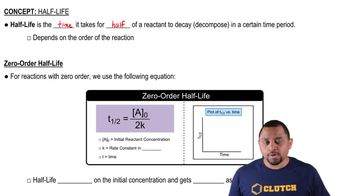
Half-Life

Half-life is the time required for half of the radioactive nuclei in a sample to decay. For first-order reactions, this is a constant value that characterizes the decay rate of the substance. In the case of plutonium-239, its half-life is 24,000 years, meaning after this period, half of the original amount will remain.
Video consigliato:
Percorso guidato
02:17
Zero-Order Half-life

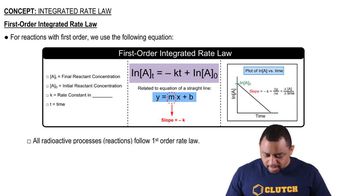
First-Order Kinetics

First-order kinetics refers to a reaction rate that is directly proportional to the concentration of one reactant. In radioactive decay, the rate at which a substance decays is proportional to the amount of the substance present. This means that as the quantity decreases, the rate of decay also decreases, leading to an exponential decay pattern.
Video consigliato:
Percorso guidato
02:29
First-Order Reactions

Exponential Decay

Exponential decay describes the process by which a quantity decreases at a rate proportional to its current value. In radioactive decay, the amount of substance remaining can be calculated using the formula N(t) = N0 * e^(-kt), where N0 is the initial quantity, k is the decay constant, and t is time. This concept is crucial for determining how long it takes for a substance to decay to a specific amount, such as one atom.
Video consigliato: