
Ch.15 - Chemical Kinetics
Tro - Chemistry: A Molecular Approach 6th Edition
Tro6th EditionChemistry: A Molecular ApproachISBN: 9780137832217Non è quello che usi tu?Cambia libro di testo
Capitolo 15, Problema 105b

The kinetics of this reaction were studied as a function of temperature. (The reaction is first order in each reactant and second order overall.)
C2H5Br(aq) + OH- (aq) → C2H5OH(l) + Br- (aq)
Temperature (°C) k (L,mol •s)
25 8.81⨉10-5
35 0.000285
45 0.000854
55 0.00239
65 0.00633
b. Determine the rate constant at 15 °C.

Guida verificata passo dopo passo
1
Identify that the problem involves determining the rate constant at a different temperature using the Arrhenius equation.
The Arrhenius equation is given by: k = A * e^(-Ea/(RT)), where k is the rate constant, A is the pre-exponential factor, Ea is the activation energy, R is the gas constant (8.314 J/mol*K), and T is the temperature in Kelvin.
To find the rate constant at 15 °C, first convert the temperatures from Celsius to Kelvin by adding 273.15 to each temperature.
Use the given rate constants at different temperatures to plot ln(k) versus 1/T (in Kelvin) and determine the slope, which is equal to -Ea/R.
Once the activation energy (Ea) is determined, use the Arrhenius equation to calculate the rate constant at 15 °C by substituting the values of Ea, R, and the temperature in Kelvin into the equation.

Risposta video verificata per un problema simile:

Questa soluzione video è stata consigliata dai nostri tutor come utile per risolvere questo problema.
Durata del video:
3m

Concetti chiave

Ecco i concetti essenziali che devi comprendere per rispondere correttamente alla domanda.

Reaction Order

The order of a reaction refers to the power to which the concentration of a reactant is raised in the rate law. In this case, the reaction is first order in each reactant, meaning the rate is directly proportional to the concentration of each reactant. Understanding reaction order is crucial for determining how changes in concentration affect the reaction rate.
Video consigliato:
Percorso guidato
00:36
Average Bond Order

Arrhenius Equation

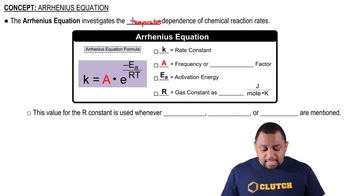
The Arrhenius equation describes how the rate constant (k) of a reaction changes with temperature. It is expressed as k = A * e^(-Ea/RT), where A is the pre-exponential factor, Ea is the activation energy, R is the gas constant, and T is the temperature in Kelvin. This relationship allows us to estimate the rate constant at different temperatures, which is essential for solving the given problem.
Video consigliato:
Percorso guidato
01:20
Arrhenius Equation

Rate Constant (k)

The rate constant (k) is a proportionality factor in the rate law that relates the rate of a reaction to the concentrations of the reactants. It varies with temperature and is specific to each reaction. In this question, determining the rate constant at 15 °C requires understanding how k changes with temperature, which can be inferred from the provided data.
Video consigliato:
Percorso guidato
01:14
Equilibrium Constant K