
Ch.16 - Chemical Equilibrium
Tro - Chemistry: A Molecular Approach 6th Edition
Tro6th EditionChemistry: A Molecular ApproachISBN: 9780137832217Non è quello che usi tu?Cambia libro di testo
Capitolo 16, Problema 34a

Calculate Kp for each reaction. a. I2(g) + Cl2(g) ⇌ 2 ICl(g) Kc = 81.9 (at 298 K)

Guida verificata passo dopo passo
1
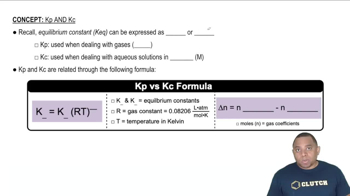
Identify the relationship between Kc and Kp using the equation: Kp = Kc(RT)^Δn.
Determine Δn, the change in moles of gas, by subtracting the sum of the moles of gaseous reactants from the sum of the moles of gaseous products. For the reaction I2(g) + Cl2(g) ⇌ 2 ICl(g), calculate Δn.
Use the ideal gas constant R = 0.0821 L·atm/(mol·K) and the temperature T = 298 K.
Substitute the values of Kc, R, T, and Δn into the equation Kp = Kc(RT)^Δn.
Simplify the expression to find the value of Kp.

Risposta video verificata per un problema simile:

Questa soluzione video è stata consigliata dai nostri tutor come utile per risolvere questo problema.
Durata del video:
2m

Concetti chiave

Ecco i concetti essenziali che devi comprendere per rispondere correttamente alla domanda.

Equilibrium Constant (Kc and Kp)

The equilibrium constant (K) quantifies the ratio of the concentrations of products to reactants at equilibrium for a given reaction. Kc refers to concentrations in molarity, while Kp refers to partial pressures in atmospheres. The relationship between Kc and Kp is given by the equation Kp = Kc(RT)^(Δn), where Δn is the change in moles of gas, R is the ideal gas constant, and T is the temperature in Kelvin.
Video consigliato:
Percorso guidato
02:06
Kp vs. Kc Formula

Partial Pressure

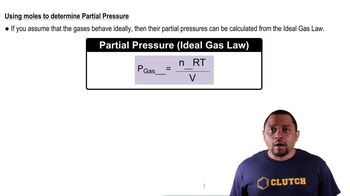
Partial pressure is the pressure exerted by a single component of a gas mixture. According to Dalton's Law, the total pressure of a gas mixture is the sum of the partial pressures of its individual gases. In the context of Kp, the partial pressures of the gaseous reactants and products are used to calculate the equilibrium constant, reflecting the behavior of gases in a reaction.
Video consigliato:
Percorso guidato
00:48
Partial Pressure Calculation

Temperature Dependence of K

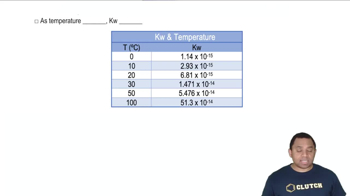
The value of the equilibrium constant (K) is temperature-dependent, meaning it can change with variations in temperature. For exothermic reactions, increasing temperature typically decreases K, while for endothermic reactions, it increases K. Understanding this dependence is crucial when calculating Kp from Kc, as the temperature at which the equilibrium constants are measured must be consistent.
Video consigliato:
Percorso guidato
01:24
Kw Temperature Dependence