
Ch.16 - Chemical Equilibrium
Tro - Chemistry: A Molecular Approach 6th Edition
Tro6th EditionChemistry: A Molecular ApproachISBN: 9780137832217Non è quello che usi tu?Cambia libro di testo
Capitolo 16, Problema 59

Consider the reaction: HC2H3O2(aq) + H2O(l) ⇌ H3O+(aq) + C2H3O2-(aq) Kc = 1.8⨉10-5 at 25°C If a solution initially contains 0.210 M HC2H3O2, what is the equilibrium concentration of H3O+ at 25 °C?

Guida verificata passo dopo passo
1
Write the expression for the equilibrium constant (Kc) for the reaction: \( K_c = \frac{[H_3O^+][C_2H_3O_2^-]}{[HC_2H_3O_2]} \).
Set up an ICE table (Initial, Change, Equilibrium) to track the concentrations of reactants and products. Initially, [HC_2H_3O_2] = 0.210 M, and [H3O+] and [C2H3O2-] are 0 M.
Let 'x' be the change in concentration of H3O+ and C2H3O2- formed at equilibrium. Therefore, the change in concentration of HC2H3O2 is -x.
At equilibrium, the concentrations will be [HC2H3O2] = 0.210 - x, [H3O+] = x, and [C2H3O2-] = x.
Substitute the equilibrium concentrations into the Kc expression and solve for x, which represents the equilibrium concentration of H3O+.

Risposta video verificata per un problema simile:

Questa soluzione video è stata consigliata dai nostri tutor come utile per risolvere questo problema.

Concetti chiave

Ecco i concetti essenziali che devi comprendere per rispondere correttamente alla domanda.

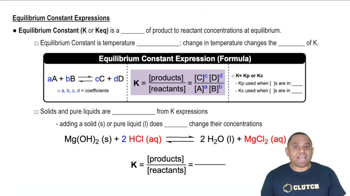
Equilibrium Constant (Kc)

The equilibrium constant, Kc, quantifies the ratio of the concentrations of products to reactants at equilibrium for a reversible reaction. It is calculated using the formula Kc = [products]/[reactants], where the concentrations are raised to the power of their coefficients in the balanced equation. A small Kc value, like 1.8 x 10^-5, indicates that at equilibrium, the reaction favors the reactants over the products.
Video consigliato:
Percorso guidato
03:20
Equilibrium Constant Expressions

Acid-Base Equilibrium

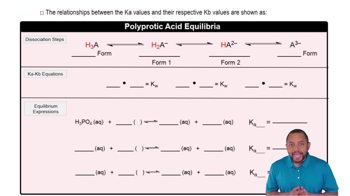
In the context of the given reaction, HC2H3O2 (acetic acid) acts as a weak acid that partially dissociates in water to form H3O+ (hydronium ion) and C2H3O2- (acetate ion). Understanding the concept of weak acids is crucial, as they do not completely ionize in solution, leading to an equilibrium state where both the undissociated acid and its ions coexist.
Video consigliato:
Percorso guidato
6:47
Triprotic Acid Equilibrium

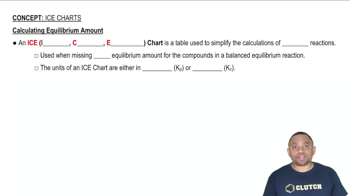
ICE Table (Initial, Change, Equilibrium)

An ICE table is a tool used to organize the initial concentrations, the changes in concentrations as the reaction proceeds, and the equilibrium concentrations of the species involved in a chemical reaction. By setting up an ICE table for this reaction, one can systematically determine the equilibrium concentrations of H3O+ and other species, facilitating the calculation of the desired equilibrium concentration.
Video consigliato:
Percorso guidato
01:14
ICE Charts and Equilibrium Amount