Ch.17 - Acids and Bases
Tro - Chemistry: A Molecular Approach 6th Edition
Tro6th EditionChemistry: A Molecular ApproachISBN: 9780137832217Non è quello che usi tu?Cambia libro di testo
Capitolo 17, Problema 116a

Calculate the [H3O+] and pH of each polyprotic acid solution.
a. 0.125 M H2CO3

Guida verificata passo dopo passo
1
Identify that \(\text{H}_2\text{CO}_3\) is a diprotic acid, meaning it can donate two protons (H+ ions) in solution.
Write the dissociation equations for \(\text{H}_2\text{CO}_3\): \(\text{H}_2\text{CO}_3 \rightleftharpoons \text{H}^+ + \text{HCO}_3^-\) and \(\text{HCO}_3^- \rightleftharpoons \text{H}^+ + \text{CO}_3^{2-}\).
Use the first dissociation constant \(K_{a1}\) to find the concentration of \(\text{H}^+\) from the first dissociation: \(K_{a1} = \frac{[\text{H}^+][\text{HCO}_3^-]}{[\text{H}_2\text{CO}_3]}\).
Assume that the concentration of \(\text{H}^+\) from the second dissociation is negligible compared to the first, and calculate \([\text{H}^+]\) using \(K_{a1}\).
Calculate the pH using the formula \(\text{pH} = -\log[\text{H}^+]\).

Risposta video verificata per un problema simile:

Questa soluzione video è stata consigliata dai nostri tutor come utile per risolvere questo problema.
Durata del video:
8m

Concetti chiave

Ecco i concetti essenziali che devi comprendere per rispondere correttamente alla domanda.

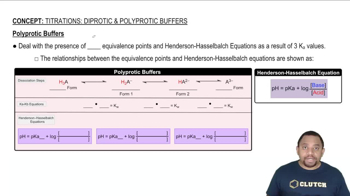
Polyprotic Acids

Polyprotic acids are acids that can donate more than one proton (H+) per molecule in a solution. For example, carbonic acid (H2CO3) can lose two protons, resulting in bicarbonate (HCO3-) and carbonate (CO3^2-). Understanding the stepwise dissociation of these acids is crucial for calculating the concentrations of hydronium ions ([H3O+]) and the resulting pH.
Video consigliato:
Percorso guidato
03:25
Polyprotic Buffers

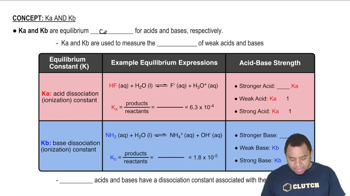
Dissociation Constants (Ka)

Each dissociation step of a polyprotic acid has a corresponding acid dissociation constant (Ka), which quantifies the strength of the acid in each step. For H2CO3, the first dissociation (H2CO3 ⇌ H+ + HCO3-) has a different Ka than the second (HCO3- ⇌ H+ + CO3^2-). These constants are essential for calculating the equilibrium concentrations of the species in solution and ultimately determining [H3O+].
Video consigliato:
Percorso guidato
03:50
Characteristics of Ka and Kb

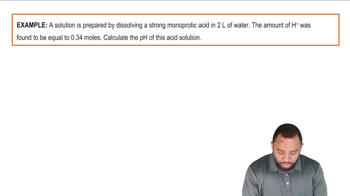
pH Calculation

pH is a measure of the acidity of a solution, defined as the negative logarithm of the hydronium ion concentration: pH = -log[H3O+]. To calculate pH for a polyprotic acid, one must first determine the [H3O+] from the dissociation equilibria, considering both dissociation steps. This requires applying the principles of equilibrium and the dissociation constants to find the final concentration of hydronium ions.
Video consigliato:
Percorso guidato
02:15
pH Calculation Example