Ch.17 - Acids and Bases
Tro - Chemistry: A Molecular Approach 6th Edition
Tro6th EditionChemistry: A Molecular ApproachISBN: 9780137832217Non è quello che usi tu?Cambia libro di testo
Capitolo 17, Problema 40d

Classify each acid as strong or weak. If the acid is weak, write an expression for the acid ionization constant (Ka). d. H2CO3

Guida verificata passo dopo passo
1
Step 1: Identify the given acid. In this case, the acid is H2CO3, also known as carbonic acid.
Step 2: Determine whether the acid is strong or weak. Strong acids completely ionize in water, while weak acids only partially ionize. H2CO3 is a weak acid because it does not completely ionize in water.
Step 3: Write the ionization reaction for the weak acid. For H2CO3, the ionization reaction in water is: H2CO3(aq) ⇌ H+(aq) + HCO3-(aq)
Step 4: Write the expression for the acid ionization constant (Ka). The general form of the Ka expression is [products]/[reactants]. For H2CO3, the Ka expression is: Ka = [H+][HCO3-]/[H2CO3]
Step 5: Note that in the Ka expression, the concentration of water is not included because it remains essentially constant during the reaction.

Risposta video verificata per un problema simile:

Questa soluzione video è stata consigliata dai nostri tutor come utile per risolvere questo problema.
Durata del video:
1m

Concetti chiave

Ecco i concetti essenziali che devi comprendere per rispondere correttamente alla domanda.

Strong vs. Weak Acids

Strong acids completely dissociate in water, releasing all their protons (H+), while weak acids only partially dissociate. This distinction is crucial for understanding acid behavior in solution, as it affects pH and reactivity. Common strong acids include HCl and HNO3, whereas weak acids include acetic acid and carbonic acid (H2CO3).
Video consigliato:
Percorso guidato
02:19
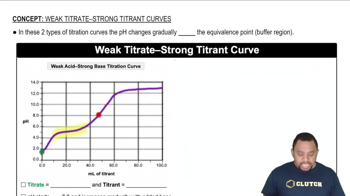
Weak Acid-Strong Base Titration Curve

Acid Ionization Constant (Ka)

The acid ionization constant (Ka) quantifies the strength of a weak acid by measuring the extent of its dissociation in water. It is defined by the equilibrium expression: Ka = [H+][A-]/[HA], where [H+] is the concentration of hydrogen ions, [A-] is the concentration of the conjugate base, and [HA] is the concentration of the undissociated acid. A larger Ka value indicates a stronger weak acid.
Video consigliato:
Percorso guidato
03:50
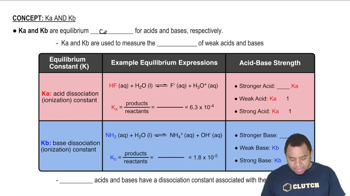
Characteristics of Ka and Kb

Carbonic Acid (H2CO3)

Carbonic acid (H2CO3) is a weak acid formed in solution when carbon dioxide (CO2) dissolves in water. It partially dissociates into bicarbonate (HCO3-) and hydrogen ions (H+), making it an important component in biological systems and buffering processes. Its ionization can be represented by the equation: H2CO3 ⇌ H+ + HCO3-, illustrating its weak acid nature.
Video consigliato:
Percorso guidato
01:38
Diprotic Acids and Bases Example