Ch.17 - Acids and Bases
Tro - Chemistry: A Molecular Approach 6th Edition
Tro6th EditionChemistry: A Molecular ApproachISBN: 9780137832217Non è quello che usi tu?Cambia libro di testo
Capitolo 17, Problema 128a

Classify each species as either a Lewis acid or a Lewis base. a. BeCl2

Guida verificata passo dopo passo
1
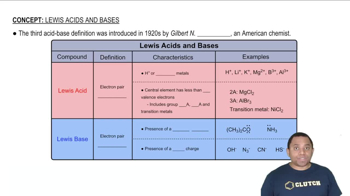
Identify the definition of a Lewis acid and a Lewis base: A Lewis acid is a species that can accept an electron pair, while a Lewis base is a species that can donate an electron pair.
Examine the electronic structure of BeCl2: Beryllium (Be) is in group 2 of the periodic table and typically forms compounds where it has a +2 oxidation state, resulting in an electron-deficient central atom.
Consider the molecular geometry of BeCl2: It is a linear molecule with beryllium at the center bonded to two chlorine atoms, which are more electronegative and pull electron density away from beryllium.
Determine the electron pair availability: Since Be in BeCl2 is electron-deficient, it has empty orbitals that can accept electron pairs, making it a potential Lewis acid.
Classify BeCl2: Based on its ability to accept electron pairs due to its electron-deficient nature, BeCl2 is classified as a Lewis acid.

Risposta video verificata per un problema simile:

Questa soluzione video è stata consigliata dai nostri tutor come utile per risolvere questo problema.
Durata del video:
2m

Concetti chiave

Ecco i concetti essenziali che devi comprendere per rispondere correttamente alla domanda.

Lewis Acids and Bases

Lewis acids are species that can accept an electron pair, while Lewis bases are species that can donate an electron pair. This definition expands the concept of acids and bases beyond protons (H+) to include electron pair interactions, making it applicable to a wider range of chemical reactions.
Video consigliato:
Percorso guidato
05:04
Lewis Acids and Bases

Electron Pair Donation

In the context of Lewis theory, a Lewis base donates an electron pair to form a covalent bond with a Lewis acid. This donation is crucial in understanding how different chemical species interact, as it determines the direction of electron flow and the formation of new compounds.
Video consigliato:
Percorso guidato
00:47
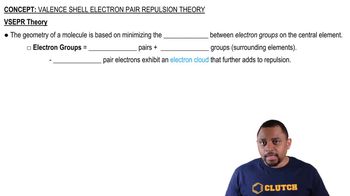
Valence Shell Electron Pair Repulsion Theory

Molecular Geometry and Hybridization

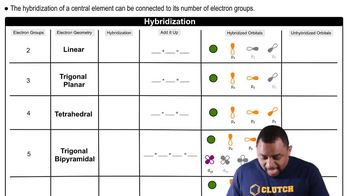
The molecular geometry and hybridization of a species influence its ability to act as a Lewis acid or base. For example, BeCl2 has a linear geometry and does not have a lone pair of electrons, which makes it a Lewis acid as it can accept electron pairs from bases during chemical reactions.
Video consigliato:
Percorso guidato
03:06
Hybridization and Electron Geometry