Ch.17 - Acids and Bases
Tro - Chemistry: A Molecular Approach 6th Edition
Tro6th EditionChemistry: A Molecular ApproachISBN: 9780137832217Non è quello che usi tu?Cambia libro di testo
Capitolo 17, Problema 33a,c

In each reaction, identify the Brønsted–Lowry acid, the Brønsted–Lowry base, the conjugate acid, and the conjugate base. a. H2CO3(aq) + H2O(l) ⇌ H3O+(aq) + HCO3–(aq) c. HNO3(aq) + H2O(l) → H3O+(aq) + NO3–(aq)

Guida verificata passo dopo passo
1
Identify the Brønsted–Lowry acid: Look for the species that donates a proton (H+). In this reaction, H2CO3 donates a proton to H2O.
Identify the Brønsted–Lowry base: Look for the species that accepts a proton. In this reaction, H2O accepts a proton from H2CO3.
Determine the conjugate acid: This is the species formed when the base gains a proton. Here, H3O+ is the conjugate acid formed from H2O.
Determine the conjugate base: This is the species formed when the acid loses a proton. Here, HCO3- is the conjugate base formed from H2CO3.
Summarize the roles: H2CO3 is the Brønsted–Lowry acid, H2O is the Brønsted–Lowry base, H3O+ is the conjugate acid, and HCO3- is the conjugate base.

Risposta video verificata per un problema simile:

Questa soluzione video è stata consigliata dai nostri tutor come utile per risolvere questo problema.
Durata del video:
1m

Concetti chiave

Ecco i concetti essenziali che devi comprendere per rispondere correttamente alla domanda.

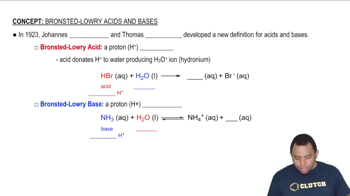
Brønsted–Lowry Acid-Base Theory

The Brønsted–Lowry theory defines acids as proton donors and bases as proton acceptors. In this framework, an acid releases a hydrogen ion (H+) in a reaction, while a base accepts that ion. This theory expands the understanding of acid-base reactions beyond just the presence of hydroxide ions, allowing for a broader range of chemical interactions.
Video consigliato:
Percorso guidato
02:08
Bronsted-Lowry Acid-Base Theory

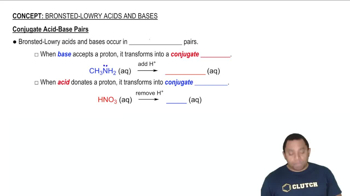
Conjugate Acid and Base

In the context of Brønsted–Lowry theory, a conjugate acid is formed when a base accepts a proton, while a conjugate base is what remains after an acid donates a proton. This relationship is crucial for understanding the reversible nature of acid-base reactions, where the products can also act as acids or bases in subsequent reactions.
Video consigliato:
Percorso guidato
01:30
Conjugate Acid-Base Pairs

Identifying Species in Reactions

To analyze acid-base reactions, it is essential to identify the roles of each species involved. In the given reaction, H2CO3 acts as the Brønsted–Lowry acid by donating a proton to H2O, which acts as the Brønsted–Lowry base. The resulting H3O+ is the conjugate acid of water, while HCO3- is the conjugate base of carbonic acid, illustrating the dynamic nature of these chemical species.
Video consigliato:
Percorso guidato
03:03
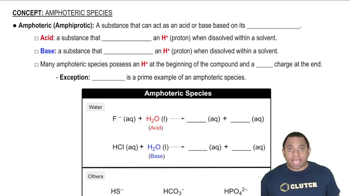
Amphoteric Species