
Ch.17 - Acids and Bases
Tro - Chemistry: A Molecular Approach 6th Edition
Tro6th EditionChemistry: A Molecular ApproachISBN: 9780137832217Non è quello che usi tu?Cambia libro di testo
Capitolo 17, Problema 145

Write net ionic equations for the reactions that take place when aqueous solutions of the following substances are mixed: a. sodium cyanide and nitric acid b. ammonium chloride and sodium hydroxide c. sodium cyanide and ammonium bromide d. potassium hydrogen sulfate and lithium acetate e. sodium hypochlorite and ammonia

Guida verificata passo dopo passo
1
Identify the chemical formulas of the reactants: sodium cyanide (NaCN) and nitric acid (HNO₃).
Write the balanced molecular equation for the reaction: NaCN(aq) + HNO₃(aq) → NaNO₃(aq) + HCN(g).
Determine the states of matter for each compound: NaCN and HNO₃ are aqueous, NaNO₃ is aqueous, and HCN is a gas.
Write the complete ionic equation by dissociating all strong electrolytes into their ions: Na⁺(aq) + CN⁻(aq) + H⁺(aq) + NO₃⁻(aq) → Na⁺(aq) + NO₃⁻(aq) + HCN(g).
Cancel out the spectator ions (Na⁺ and NO₃⁻) to write the net ionic equation: CN⁻(aq) + H⁺(aq) → HCN(g).

Risposta video verificata per un problema simile:

Questa soluzione video è stata consigliata dai nostri tutor come utile per risolvere questo problema.
Durata del video:
3m

Concetti chiave

Ecco i concetti essenziali che devi comprendere per rispondere correttamente alla domanda.

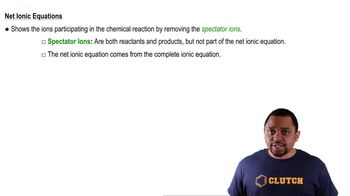
Net Ionic Equations

Net ionic equations represent the actual chemical species that participate in a reaction, excluding spectator ions. They are derived from complete ionic equations by removing ions that do not change during the reaction. This simplification helps to focus on the essential chemical changes occurring in the solution.
Video consigliato:
Percorso guidato
00:51
Net Ionic Equations

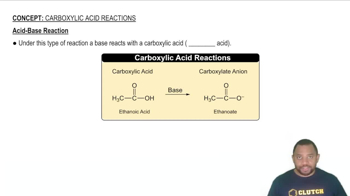
Acid-Base Reactions

Acid-base reactions involve the transfer of protons (H+) between reactants. In this context, nitric acid (a strong acid) donates protons, while sodium cyanide can act as a weak base. Understanding the behavior of acids and bases is crucial for predicting the products of their reactions.
Video consigliato:
Percorso guidato
01:09
Acid-Base Reaction

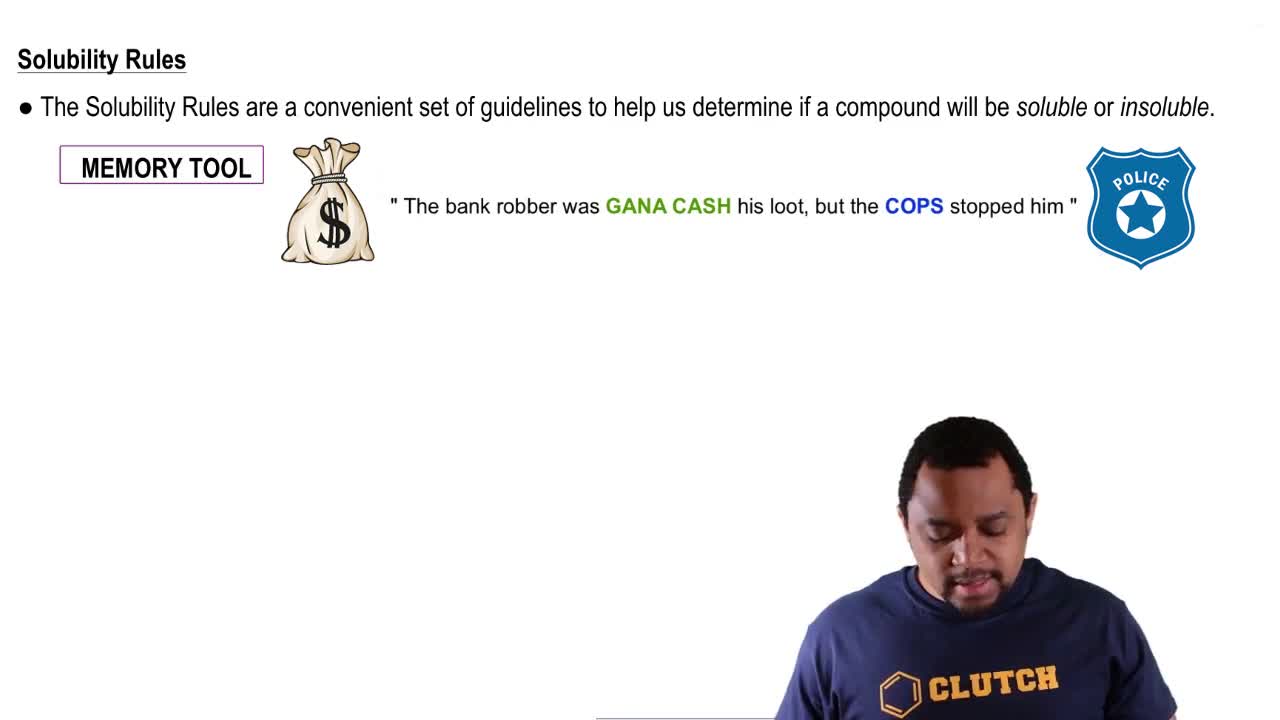
Solubility Rules

Solubility rules help predict whether a compound will dissolve in water or form a precipitate. For example, sodium salts are generally soluble, while certain metal cyanides may not be. Knowing these rules is essential for determining the species present in solution and writing accurate net ionic equations.
Video consigliato:
Percorso guidato
00:28
Solubility Rules