
Domanda del libro di testo
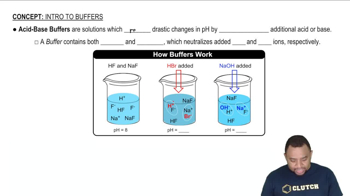
Determine whether or not the mixing of each pair of solutions results in a buffer. b.155.0 mL of 0.15 M NH3 ; 155.0 mL of 0.10 M HCl

 Guida verificata passo dopo passo
 03:02
03:02
 01:09
01:09 05:56
05:56Determine whether or not the mixing of each pair of solutions results in a buffer. b.155.0 mL of 0.15 M NH3 ; 155.0 mL of 0.10 M HCl
The fluids within cells are buffered by H2PO4- and HPO42- . b. Could a buffer system employing H3PO4 as the weak acid and H2PO4- as the weak base be used as a buffer system within cells? Explain.
Blood is buffered by carbonic acid and the bicarbonate ion. Normal blood plasma is 0.024 M in HCO3- and 0.0012 M H2CO3 (pKa1 for H2CO3 at body temperature is 6.1).
c. Given the volume from part (b), what mass of NaOH can be neutralized before the pH rises above 7.8?
Determine whether or not the mixing of each pair of solutions results in a buffer. c. 225.0 mL of 0.10 M NH3 ; 250.0 mL of 0.15 M NH4Cl
Determine whether or not the mixing of each pair of solutions results in a buffer. a. 155.0 mL of 0.15 M NH3 ; 175.0 mL of 0.17 M HCl
Blood is buffered by carbonic acid and the bicarbonate ion. Normal blood plasma is 0.024 M in HCO3- and 0.0012 M H2CO3 (pKa1 for H2CO3 at body temperature is 6.1).
a. What is the pH of blood plasma?