A 25.0-mL sample of 0.125 M pyridine is titrated with 0.100 M HCl. Calculate the pH at each volume of added acid: 10 mL.
Ch.18 - Aqueous Ionic Equilibrium

Tro6th EditionChemistry: A Molecular ApproachISBN: 9780137832217Non è quello che usi tu?Cambia libro di testo
Capitolo 18, Problema 80a
A 25.0-mL sample of 0.125 M pyridine is titrated with 0.100 M HCl. Calculate the pH at each volume of added acid: 0 mL.
Guida verificata passo dopo passo1
Identify the initial conditions: You have a 25.0 mL sample of 0.125 M pyridine, a weak base, and you are adding 0.100 M HCl, a strong acid.
Recognize that at 0 mL of added HCl, no acid has been added yet, so the solution contains only pyridine.
Use the formula for the base dissociation constant (K_b) to find the concentration of hydroxide ions (OH⁻) in the solution: \[ \text{C}_6\text{H}_5\text{N} + \text{H}_2\text{O} \rightleftharpoons \text{C}_6\text{H}_5\text{NH}^+ + \text{OH}^- \]
Calculate the initial concentration of OH⁻ using the expression for K_b: \[ K_b = \frac{[\text{C}_6\text{H}_5\text{NH}^+][\text{OH}^-]}{[\text{C}_6\text{H}_5\text{N}]} \]
Convert the concentration of OH⁻ to pOH, and then to pH using the relationship: \[ \text{pH} = 14 - \text{pOH} \]

Risposta video verificata per un problema simile:
Questa soluzione video è stata consigliata dai nostri tutor come utile per risolvere questo problema.
Durata del video:
3mConcetti chiave
Ecco i concetti essenziali che devi comprendere per rispondere correttamente alla domanda.
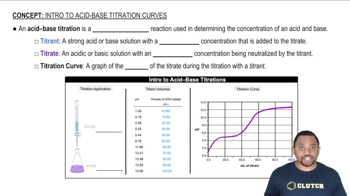
Acid-Base Titration
An acid-base titration is a quantitative analytical method used to determine the concentration of an acid or base in a solution. In this process, a solution of known concentration (the titrant) is gradually added to a solution of unknown concentration until the reaction reaches its equivalence point, where the amount of acid equals the amount of base. Understanding this concept is crucial for calculating pH changes during the titration.
Video consigliato:
Percorso guidato
Acid-Base Titration
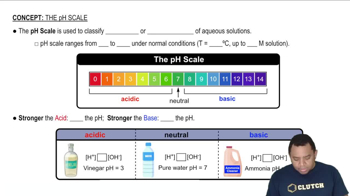
pH Scale
The pH scale measures the acidity or basicity of a solution, ranging from 0 to 14. A pH of 7 is considered neutral, while values below 7 indicate acidity and values above 7 indicate basicity. The pH is calculated using the formula pH = -log[H+], where [H+] is the concentration of hydrogen ions in the solution. Knowing how to calculate pH is essential for determining the acidity of the solution at various points during the titration.
Video consigliato:
Percorso guidato
The pH Scale
Weak Base and Strong Acid Reaction
In this titration, pyridine acts as a weak base, while HCl is a strong acid. When a weak base is titrated with a strong acid, the pH will initially decrease slowly until the equivalence point is approached, after which it will drop sharply. Understanding the behavior of weak bases in the presence of strong acids is important for predicting pH changes throughout the titration process.
Video consigliato:
Percorso guidato
Strong Acid-Strong Base Titration
Pratica correlata
Domanda del libro di testo
470
views
Domanda del libro di testo
Consider the titration of a 25.0-mL sample of 0.175 M CH3NH2 with 0.150 M HBr. Determine each quantity. e. the pH at the equivalence point
588
views
Domanda del libro di testo
A 25.0-mL sample of 0.125 M pyridine is titrated with 0.100 M HCl. Calculate the pH at each volume of added acid: equivalence point.
1863
views
Domanda del libro di testo
Consider the titration of a 25.0-mL sample of 0.175 M CH3NH2 with 0.150 M HBr. Determine each quantity. c. the pH at 5.0 mL of added acid
3117
views
Domanda del libro di testo
Consider the titration of a 25.0-mL sample of 0.175 M CH3NH2 with 0.150 M HBr. Determine each quantity. a. the initial pH
632
views
Domanda del libro di testo
A 25.0-mL sample of 0.125 M pyridine is titrated with 0.100 M HCl. Calculate the pH at each volume of added acid: 20 mL.
356
views