Ch.18 - Aqueous Ionic Equilibrium
Tro - Chemistry: A Molecular Approach 6th Edition
Tro6th EditionChemistry: A Molecular ApproachISBN: 9780137832217Non è quello che usi tu?Cambia libro di testo
Capitolo 18, Problema 115

A solution is made 1.1⨉10-3 M in Zn(NO3)2 and 0.150 M in NH3. After the solution reaches equilibrium, what concentration of Zn2+(aq) remains?

Guida verificata passo dopo passo
1
Identify the relevant chemical equilibrium: The complexation reaction between Zn(NO_3)_2 and NH_3 forms a complex ion, typically Zn(NH_3)_4^{2+}. The equilibrium can be represented as: Zn^{2+} + 4NH_3 \(\rightleftharpoons\) Zn(NH_3)_4^{2+}.
Write the expression for the equilibrium constant (K_f) for the formation of the complex ion: K_f = \(\frac{[Zn(NH_3)_4^{2+}\)]}{[Zn^{2+}][NH_3]^4}.
Determine the initial concentrations: Initially, [Zn^{2+}] = 1.1 \(\times\) 10^{-3} M and [NH_3] = 0.150 M. Assume [Zn(NH_3)_4^{2+}] = 0 M initially.
Set up an ICE (Initial, Change, Equilibrium) table to track the changes in concentrations as the system reaches equilibrium. Define the change in concentration of Zn^{2+} as -x, NH_3 as -4x, and Zn(NH_3)_4^{2+} as +x.
Substitute the equilibrium concentrations into the K_f expression and solve for x, which represents the change in concentration of Zn^{2+}. The equilibrium concentration of Zn^{2+} will be the initial concentration minus x.

Risposta video verificata per un problema simile:

Questa soluzione video è stata consigliata dai nostri tutor come utile per risolvere questo problema.
Durata del video:
7m

Concetti chiave

Ecco i concetti essenziali che devi comprendere per rispondere correttamente alla domanda.

Equilibrium in Chemical Reactions

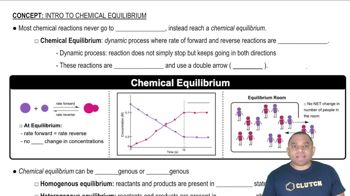
Equilibrium in chemical reactions refers to the state where the rates of the forward and reverse reactions are equal, resulting in constant concentrations of reactants and products. In this context, understanding how the concentrations of Zn2+ and NH3 interact at equilibrium is crucial for determining the final concentration of Zn2+ in the solution.
Video consigliato:
Percorso guidato
04:21
Chemical Equilibrium Concepts

Complex Ion Formation

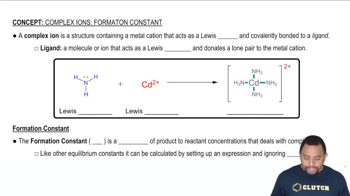
Complex ion formation occurs when metal ions, such as Zn2+, interact with ligands like NH3 to form a complex. This process can significantly affect the concentration of free metal ions in solution, as the formation of complexes reduces the amount of free Zn2+ available, which is essential for calculating the equilibrium concentration.
Video consigliato:
Percorso guidato
02:20
Complex Ions and Formation Constant

Le Chatelier's Principle

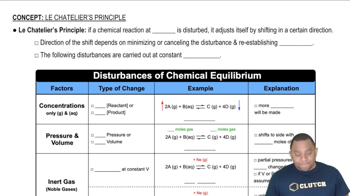
Le Chatelier's Principle states that if a system at equilibrium is disturbed, the system will adjust to counteract the disturbance and restore a new equilibrium. In this scenario, changes in concentration of NH3 or Zn(NO3)2 will shift the equilibrium position, impacting the concentration of Zn2+ ions in the solution.
Video consigliato:
Percorso guidato
07:32
Le Chatelier's Principle