Ch.18 - Aqueous Ionic Equilibrium
Tro - Chemistry: A Molecular Approach 6th Edition
Tro6th EditionChemistry: A Molecular ApproachISBN: 9780137832217Non è quello che usi tu?Cambia libro di testo
Capitolo 18, Problema 55c

Determine whether or not the mixing of each pair of solutions results in a buffer. c. 55.0 mL of 0.15 M HF; 85.0 mL of 0.10 M NaF

Guida verificata passo dopo passo
1
Identify the components of the solutions: HF is a weak acid and NaF is its conjugate base.
Calculate the moles of HF using the formula: moles = concentration \( \times \) volume. Convert the volume from mL to L before calculation.
Calculate the moles of NaF using the same formula: moles = concentration \( \times \) volume. Again, convert the volume from mL to L before calculation.
Determine if the solution can act as a buffer: A buffer solution contains a weak acid and its conjugate base in significant amounts.
Compare the moles of HF and NaF to ensure both are present in significant amounts to resist changes in pH, confirming the presence of a buffer.

Risposta video verificata per un problema simile:

Questa soluzione video è stata consigliata dai nostri tutor come utile per risolvere questo problema.
Durata del video:
6m

Concetti chiave

Ecco i concetti essenziali che devi comprendere per rispondere correttamente alla domanda.

Buffer Solutions

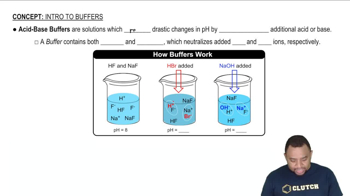
A buffer solution is a system that resists changes in pH upon the addition of small amounts of acid or base. It typically consists of a weak acid and its conjugate base or a weak base and its conjugate acid. In this case, HF (hydrofluoric acid) is a weak acid, and NaF (sodium fluoride) provides the conjugate base, F-. Together, they can form a buffer solution.
Video consigliato:
Percorso guidato
03:02
Buffer Solutions

Weak Acids and Conjugate Bases

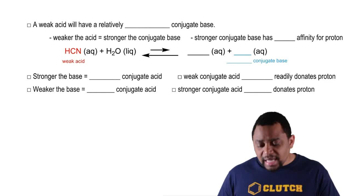
Weak acids are substances that partially dissociate in solution, establishing an equilibrium between the undissociated acid and its ions. The conjugate base is formed when the weak acid donates a proton (H+). In the given example, HF partially dissociates to produce H+ and F-, making NaF a source of F-, which can react with added H+ to maintain pH stability.
Video consigliato:
Percorso guidato
01:46
Conjugate Acid-Base Relationships

Henderson-Hasselbalch Equation

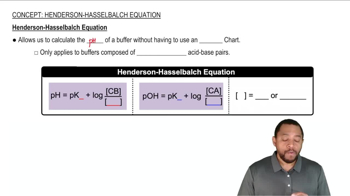
The Henderson-Hasselbalch equation is a mathematical formula used to calculate the pH of a buffer solution. It is expressed as pH = pKa + log([A-]/[HA]), where [A-] is the concentration of the conjugate base and [HA] is the concentration of the weak acid. This equation helps determine if the given concentrations of HF and NaF will effectively create a buffer by assessing their ratio.
Video consigliato:
Percorso guidato
02:40
Henderson-Hasselbalch Equation