Ch.18 - Aqueous Ionic Equilibrium
Tro - Chemistry: A Molecular Approach 6th Edition
Tro6th EditionChemistry: A Molecular ApproachISBN: 9780137832217Non è quello che usi tu?Cambia libro di testo
Capitolo 18, Problema 41a

Calculate the pH of the solution that results from each mixture. a. 50.0 mL of 0.15 M HCHO2 with 75.0 mL of 0.13 M NaCHO2

Guida verificata passo dopo passo
1
1. Identify the species in the solution. HCHO2 is a weak acid and NaCHO2 is the salt of its conjugate base, CHO2-. This is a buffer solution, so we can use the Henderson-Hasselbalch equation to calculate the pH.
2. Calculate the initial moles of HCHO2 and CHO2- in the solution. This can be done by multiplying the volume (in liters) of each solution by its molarity. Remember that the volume of the solution is the sum of the volumes of the acid and the base.
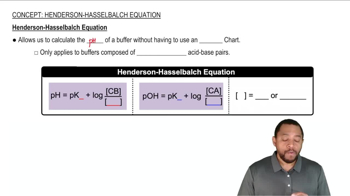
3. Use the Henderson-Hasselbalch equation, pH = pKa + log([A-]/[HA]), where [A-] is the molar concentration of the base (CHO2-) and [HA] is the molar concentration of the acid (HCHO2). The pKa value can be found in a table or given in the problem.
4. Substitute the values of pKa, [A-] and [HA] into the Henderson-Hasselbalch equation to calculate the pH of the solution.
5. If the pH is less than 7, the solution is acidic. If the pH is greater than 7, the solution is basic. If the pH is 7, the solution is neutral.

Risposta video verificata per un problema simile:

Questa soluzione video è stata consigliata dai nostri tutor come utile per risolvere questo problema.

Concetti chiave

Ecco i concetti essenziali che devi comprendere per rispondere correttamente alla domanda.

Acid-Base Chemistry

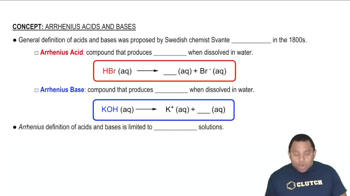
Acid-base chemistry involves the study of substances that can donate protons (acids) or accept protons (bases). In this question, HCHO2 (formic acid) acts as the acid, while NaCHO2 (sodium formate) serves as its conjugate base. Understanding the properties of acids and bases, including their dissociation in water, is essential for calculating pH.
Video consigliato:
Percorso guidato
02:00
Arrhenius Acids and Bases

Henderson-Hasselbalch Equation

The Henderson-Hasselbalch equation is a formula used to calculate the pH of a buffer solution. It relates the pH to the pKa of the acid and the ratio of the concentrations of the conjugate base to the acid. This equation is particularly useful in this scenario, as the mixture of formic acid and sodium formate creates a buffer system.
Video consigliato:
Percorso guidato
02:40
Henderson-Hasselbalch Equation

Dilution and Concentration Calculations

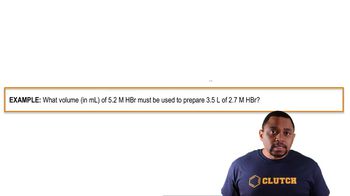
Dilution and concentration calculations are crucial for determining the final concentrations of solutes in a solution after mixing. When two solutions are combined, the total volume changes, affecting the concentrations of the individual components. Accurately calculating the new concentrations of HCHO2 and NaCHO2 after mixing is necessary to apply the Henderson-Hasselbalch equation effectively.
Video consigliato:
Percorso guidato
02:36
Dilution Calculation Example