Ch.18 - Aqueous Ionic Equilibrium
Tro - Chemistry: A Molecular Approach 6th Edition
Tro6th EditionChemistry: A Molecular ApproachISBN: 9780137832217Non è quello che usi tu?Cambia libro di testo
Capitolo 18, Problema 73c

Consider the titration of a 35.0-mL sample of 0.175 M HBr with 0.200 M KOH. Determine each quantity. c. the pH at 10.0 mL of added base

Guida verificata passo dopo passo
1
Calculate the initial moles of HBr in the solution using the formula: \( \text{moles} = \text{volume (L)} \times \text{molarity} \).
Calculate the moles of KOH added using the formula: \( \text{moles} = \text{volume (L)} \times \text{molarity} \).
Determine the moles of HBr remaining after the reaction with KOH by subtracting the moles of KOH from the initial moles of HBr.
Calculate the concentration of HBr remaining in the solution by dividing the moles of HBr remaining by the total volume of the solution in liters (initial volume of HBr + volume of KOH added).
Use the concentration of HBr to find the pH of the solution. Since HBr is a strong acid, \( \text{pH} = -\log[\text{H}^+] \), where \([\text{H}^+]\) is the concentration of HBr.

Risposta video verificata per un problema simile:

Questa soluzione video è stata consigliata dai nostri tutor come utile per risolvere questo problema.
Durata del video:
4m

Concetti chiave

Ecco i concetti essenziali che devi comprendere per rispondere correttamente alla domanda.

Titration

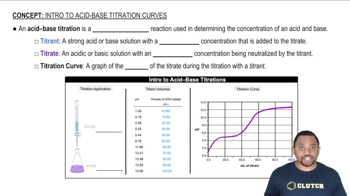
Titration is a quantitative analytical technique used to determine the concentration of a solute in a solution. It involves the gradual addition of a titrant (in this case, KOH) to a solution of the analyte (HBr) until the reaction reaches its equivalence point, where stoichiometrically equivalent amounts of acid and base have reacted. Understanding the titration process is essential for calculating pH changes during the addition of the titrant.
Video consigliato:
Percorso guidato
03:04
Acid-Base Titration

pH Scale

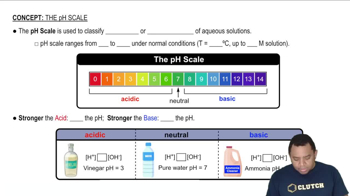
The pH scale measures the acidity or basicity of a solution, ranging from 0 to 14. A pH of 7 is considered neutral, while values below 7 indicate acidity and values above 7 indicate basicity. The pH is calculated using the concentration of hydrogen ions (H+) in the solution, and it is crucial to understand how the addition of an acid or base affects the pH during titration.
Video consigliato:

Neutralization Reaction

A neutralization reaction occurs when an acid reacts with a base to produce water and a salt, effectively neutralizing each other's properties. In this case, HBr (a strong acid) reacts with KOH (a strong base) to form water and KBr. The stoichiometry of the reaction is important for determining the pH at various points during the titration, particularly before, at, and after the equivalence point.
Video consigliato:
Percorso guidato
05:56
Lewis Dot Structures: Neutral Compounds