Determine the minimum concentration of the precipitating agent on the right to cause precipitation of the cation from the solution on the left. b. 0.085 M CaI2; K2SO4
Ch.18 - Aqueous Ionic Equilibrium

Tro6th EditionChemistry: A Molecular ApproachISBN: 9780137832217Non è quello che usi tu?Cambia libro di testo
Capitolo 18, Problema 112c
Determine the minimum concentration of the precipitating agent on the right to cause precipitation of the cation from the solution on the left. c. 0.0018 M AgNO3; RbCl
Guida verificata passo dopo passo1
Identify the ions involved in the precipitation reaction: Ag^+ from AgNO_3 and Cl^- from RbCl.
Write the balanced chemical equation for the precipitation reaction: Ag^+ (aq) + Cl^- (aq) \(\rightarrow\) AgCl (s).
Determine the solubility product constant (K_{sp}) for AgCl, which is a known value from tables.
Use the expression for the solubility product: K_{sp} = [Ag^+][Cl^-].
Rearrange the expression to solve for the minimum concentration of Cl^- needed to cause precipitation: [Cl^-] = \(\frac{K_{sp}\)}{[Ag^+]} and substitute the known values.

Risposta video verificata per un problema simile:
Questa soluzione video è stata consigliata dai nostri tutor come utile per risolvere questo problema.
Durata del video:
3mConcetti chiave
Ecco i concetti essenziali che devi comprendere per rispondere correttamente alla domanda.
Precipitation Reaction
A precipitation reaction occurs when two soluble salts react in solution to form an insoluble compound, known as a precipitate. This process is driven by the formation of a solid that separates from the liquid phase, often indicated by a change in color or turbidity. Understanding the solubility rules and the specific ions involved is crucial for predicting whether a precipitate will form.
Video consigliato:
Percorso guidato
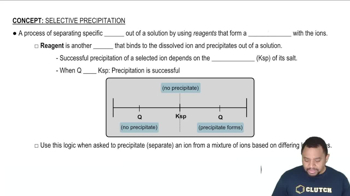
Selective Precipitation
Solubility Product Constant (Ksp)
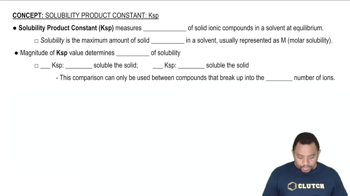
The solubility product constant (Ksp) is an equilibrium constant that quantifies the solubility of a sparingly soluble ionic compound. It is defined as the product of the molar concentrations of the ions, each raised to the power of their coefficients in the balanced equation. For precipitation to occur, the product of the concentrations of the ions in solution must exceed the Ksp value of the precipitate.
Video consigliato:
Percorso guidato
Solubility Product Constant
Concentration and Molarity
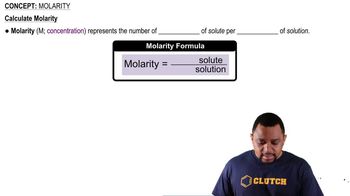
Concentration refers to the amount of a substance (solute) present in a given volume of solution, commonly expressed in molarity (M), which is moles of solute per liter of solution. Understanding how to calculate and manipulate concentrations is essential for determining the minimum amount of a precipitating agent needed to initiate precipitation. This involves stoichiometric relationships and the concept of limiting reagents in chemical reactions.
Video consigliato:
Percorso guidato
Molarity Concept
Pratica correlata
Domanda del libro di testo
561
views
Domanda del libro di testo
Predict whether a precipitate will form if you mix 75.0 mL of a NaOH solution with pOH = 2.58 with 125.0 mL of a 0.018 M MgCl2 solution. Identify the precipitate, if any.
1278
views
Domanda del libro di testo
A solution is 0.010 M in Ba2+ and 0.020 M in Ca2+. b. What is the remaining concentration of the cation that precipitates first, when the other cation begins to precipitate?
1213
views
Domanda del libro di testo
A solution is 0.010 M in Ba2+ and 0.020 M in Ca2+. a. If sodium sulfate is used to selectively precipitate one of the cations while leaving the other cation in solution, which cation will precipitate first? What minimum concentration of Na2SO4 will trigger the precipitation of the cation that precipitates first?
1308
views
1
rank