
Methyl red has a pKa of 5.0 and is red in its acid form and yellow in its basic form. If several drops of this indicator are placed in a 25.0-mL sample of 0.100 M HCl, what color will the solution appear? If 0.100 M NaOH is slowly added to the HCl sample, in what pH range will the indicator change color?
Ch.18 - Aqueous Ionic Equilibrium

Tro6th EditionChemistry: A Molecular ApproachISBN: 9780137832217Non è quello che usi tu?Cambia libro di testo
Capitolo 18, Problema 89
Referring to Table 18.1, pick an indicator for use in the titration of each acid with a strong base. a. HF
Guida verificata passo dopo passo1
Identify the type of titration: In this case, you are titrating a weak acid (HF) with a strong base.
Determine the pH at the equivalence point: For a weak acid-strong base titration, the pH at the equivalence point will be greater than 7.
Consult Table 18.1 for indicators: Look for an indicator that changes color in the pH range that includes the pH at the equivalence point.
Select an appropriate indicator: Choose an indicator whose color change range falls within the expected pH range at the equivalence point.
Verify the choice: Ensure the selected indicator provides a clear and distinct color change at the equivalence point.

Risposta video verificata per un problema simile:
Questa soluzione video è stata consigliata dai nostri tutor come utile per risolvere questo problema.
Durata del video:
5mConcetti chiave
Ecco i concetti essenziali che devi comprendere per rispondere correttamente alla domanda.
Acid-Base Titration
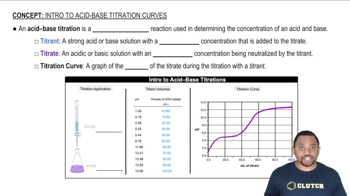
An acid-base titration is a quantitative analytical method used to determine the concentration of an acid or base in a solution. During the titration, a solution of known concentration (the titrant) is added to a solution of unknown concentration until the reaction reaches its equivalence point, where the amount of acid equals the amount of base. The choice of indicator is crucial as it signals the endpoint of the titration.
Video consigliato:
Percorso guidato
Acid-Base Titration
Indicators
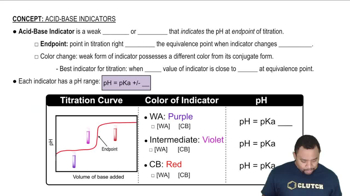
Indicators are substances that change color at a specific pH range, signaling the endpoint of a titration. The choice of indicator depends on the pH at the equivalence point of the titration. For weak acids like HF titrated with a strong base, an indicator that changes color around a pH of 7 to 10 is typically used, as the equivalence point will be above neutral pH due to the formation of a weak conjugate base.
Video consigliato:
Percorso guidato
Acid-Base Indicators
HF (Hydrofluoric Acid)
HF is a weak acid that partially dissociates in solution, meaning it does not completely ionize like strong acids. This characteristic affects the pH of the solution during titration and the choice of indicator. When titrating HF with a strong base, the resulting solution will have a higher pH at the equivalence point, necessitating an indicator that can accurately reflect this change.
Video consigliato:
Percorso guidato
Binary Acid Identification Example
Pratica correlata
Domanda del libro di testo
2078
views
1
rank
Domanda del libro di testo
Write balanced equations and expressions for Ksp for the dissolution of each ionic compound. b. PbBr2
339
views
Domanda del libro di testo
Write balanced equations and expressions for Ksp for the dissolution of each ionic compound. a. BaSO4
927
views
Domanda del libro di testo
Referring to Table 17.1, pick an indicator for use in the titration of each base with a strong acid. a. CH3NH2
Domanda del libro di testo
A 20.0-mL sample of 0.115 M sulfurous acid (H2SO3) solution is titrated with 0.1014 M KOH. At what added volume of base solution does each equivalence point occur?
1619
views
