Ch.18 - Aqueous Ionic Equilibrium
Tro - Chemistry: A Molecular Approach 6th Edition
Tro6th EditionChemistry: A Molecular ApproachISBN: 9780137832217Non è quello che usi tu?Cambia libro di testo
Capitolo 18, Problema 67a

The graphs labeled (a) and (b) show the titration curves for two equal-volume samples of monoprotic acids, one weak and one strong. Both titrations were carried out with the same concentration of strong base.
(i) What is the approximate pH at the equivalence point of each curve?

Guida verificata passo dopo passo
1
Identify the type of acid for each titration curve: strong acid or weak acid.
Recall that the pH at the equivalence point for a strong acid-strong base titration is typically around 7.
Recall that the pH at the equivalence point for a weak acid-strong base titration is greater than 7 due to the formation of a weak conjugate base.
Examine the titration curves to determine which one corresponds to the strong acid and which to the weak acid based on the pH at the equivalence point.
Estimate the pH at the equivalence point for each curve based on the above information.

Risposta video verificata per un problema simile:

Questa soluzione video è stata consigliata dai nostri tutor come utile per risolvere questo problema.
Durata del video:
4m

Concetti chiave

Ecco i concetti essenziali che devi comprendere per rispondere correttamente alla domanda.

Titration Curves

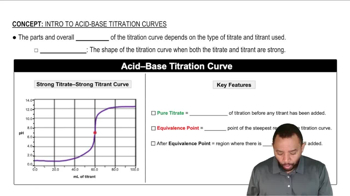
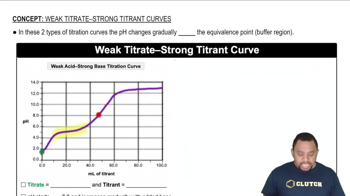
Titration curves graphically represent the change in pH of a solution as a titrant is added. In the case of monoprotic acids, the curve typically shows a gradual increase in pH until the equivalence point, where the amount of titrant added is stoichiometrically equivalent to the amount of acid present. The shape of the curve differs between strong and weak acids, with weak acids exhibiting a more gradual slope and a less pronounced jump in pH at the equivalence point.
Video consigliato:
Percorso guidato
02:16
Acid-Base Titration Curves

Equivalence Point

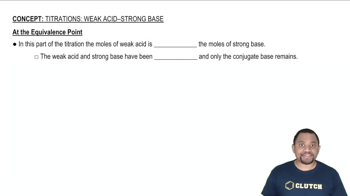
The equivalence point in a titration is the stage at which the amount of titrant added is exactly enough to completely neutralize the analyte solution. For strong acids titrated with strong bases, the pH at the equivalence point is typically around 7, as the resulting solution contains only neutral water and salt. In contrast, for weak acids, the pH at the equivalence point is higher than 7 due to the formation of a weak conjugate base that partially hydrolyzes in solution.
Video consigliato:
Percorso guidato
01:07
At the Equivalence Point

Strong vs. Weak Acids

Strong acids completely dissociate in water, releasing all their protons (H+), which results in a higher concentration of H+ ions and a lower pH. Weak acids, on the other hand, only partially dissociate, leading to a lower concentration of H+ ions and a higher pH. This fundamental difference affects the shape of the titration curve and the pH at the equivalence point, with weak acids resulting in a more basic solution at equivalence compared to strong acids.
Video consigliato:
Percorso guidato
02:19
Weak Acid-Strong Base Titration Curve