
Ch.18 - Aqueous Ionic Equilibrium
Tro - Chemistry: A Molecular Approach 6th Edition
Tro6th EditionChemistry: A Molecular ApproachISBN: 9780137832217Non è quello che usi tu?Cambia libro di testo
Capitolo 18, Problema 124

To adjust the pH of a 250.0-mL buffer solution initially containing 0.025 mol of HCHO2 and 0.025 mol of NaCHO2 to 4.10, should you add NaOH or HCl, and what mass of the correct reagent should you add?

Guida verificata passo dopo passo
1
Identify the components of the buffer solution: HCHO2 (formic acid) and NaCHO2 (sodium formate).
Use the Henderson-Hasselbalch equation: \( \text{pH} = \text{pK}_a + \log \left( \frac{[\text{A}^-]}{[\text{HA}]} \right) \), where \( \text{A}^- \) is the conjugate base (formate ion) and \( \text{HA} \) is the weak acid (formic acid).
Calculate the initial pH of the buffer using the given concentrations and the \( \text{pK}_a \) of formic acid (3.74).
Determine whether the pH needs to be increased or decreased to reach 4.10. If the pH needs to be increased, add NaOH; if it needs to be decreased, add HCl.
Calculate the amount of NaOH or HCl needed to adjust the pH to 4.10 using the buffer capacity and the change in moles of \( \text{A}^- \) or \( \text{HA} \) required. Convert this amount to mass using the molar mass of the reagent.

Concetti chiave

Ecco i concetti essenziali che devi comprendere per rispondere correttamente alla domanda.

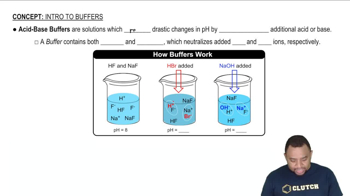
Buffer Solutions

Buffer solutions are mixtures that resist changes in pH when small amounts of acid or base are added. They typically consist of a weak acid and its conjugate base, or a weak base and its conjugate acid. In this case, the buffer is composed of formic acid (HCHO2) and sodium formate (NaCHO2), which help maintain the pH around a desired value.
Video consigliato:
Percorso guidato
03:02
Buffer Solutions

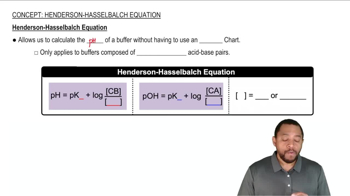
Henderson-Hasselbalch Equation

The Henderson-Hasselbalch equation relates the pH of a buffer solution to the concentration of its acid and conjugate base. It is expressed as pH = pKa + log([A-]/[HA]), where [A-] is the concentration of the base and [HA] is the concentration of the acid. This equation is essential for determining how to adjust the pH by adding either an acid or a base.
Video consigliato:
Percorso guidato
02:40
Henderson-Hasselbalch Equation

Stoichiometry of Acid-Base Reactions

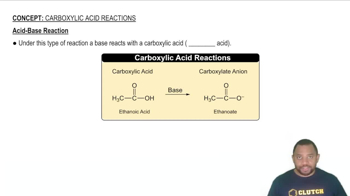
Stoichiometry involves the calculation of reactants and products in chemical reactions. In the context of adjusting pH, it is important to determine the amount of acid (HCl) or base (NaOH) needed to achieve the desired pH. This requires understanding the molar relationships and the neutralization reactions that occur when these substances are added to the buffer solution.
Video consigliato:
Percorso guidato
01:09
Acid-Base Reaction