
Ch.19 - Free Energy & Thermodynamics
Tro - Chemistry: A Molecular Approach 6th Edition
Tro6th EditionChemistry: A Molecular ApproachISBN: 9780137832217Non è quello che usi tu?Cambia libro di testo
Capitolo 19, Problema 40a

Without doing any calculations, determine the signs of ΔSsys and ΔS surr for each chemical reaction. In addition, predict under what temperatures (all temperatures, low temperatures, or high temperatures), if any, the reaction is spontaneous. a. C3H8(g) + 5 O2(g) → 3 CO2(g) + 4 H2O(g) ΔH°rxn = -2044 kJ

Guida verificata passo dopo passo
1
Identify the system and surroundings: The system is the chemical reaction given, and the surroundings are everything else around it.
Determine the sign of ΔS_sys (entropy change of the system) by comparing the number of moles of gaseous reactants and products. Here, reactants have 1 mole of C₃H₈ and 5 moles of O₂, totaling 6 moles of gas, while products have 3 moles of CO₂ and 4 moles of H₂O gas, totaling 7 moles of gas. Since the number of gas moles increases, ΔS_sys is positive.
Determine the sign of ΔS_surr (entropy change of the surroundings) using the sign of ΔH_rxn. Since ΔH°_rxn = -2044 kJ (negative), the reaction is exothermic, so heat is released to the surroundings, increasing their entropy. Therefore, ΔS_surr is positive.
Recall the Gibbs free energy equation: ΔG = ΔH - TΔS. For spontaneity, ΔG must be negative.
Since both ΔH is negative and ΔS_sys is positive, the reaction is spontaneous at all temperatures.

Risposta video verificata per un problema simile:

Questa soluzione video è stata consigliata dai nostri tutor come utile per risolvere questo problema.

Concetti chiave

Ecco i concetti essenziali che devi comprendere per rispondere correttamente alla domanda.

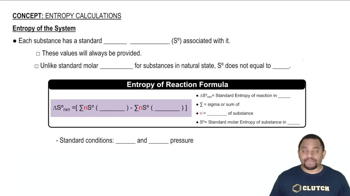
Entropy Change of the System (ΔS_sys)

Entropy (S) measures the disorder or randomness in a system. ΔS_sys refers to the change in entropy of the reacting substances. For reactions involving gases, an increase in the number of gas molecules usually means an increase in entropy, while a decrease in gas molecules leads to a decrease in entropy.
Video consigliato:
Percorso guidato
02:06
Entropy of the System

Entropy Change of the Surroundings (ΔS_surr) and Enthalpy (ΔH)

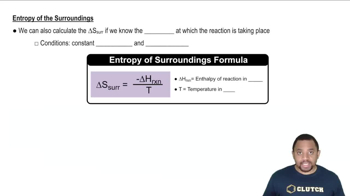
The entropy change of the surroundings is related to the heat exchanged with the surroundings, which depends on the reaction's enthalpy change (ΔH). For exothermic reactions (ΔH < 0), heat is released, increasing the surroundings' entropy (ΔS_surr > 0). For endothermic reactions (ΔH > 0), heat is absorbed, decreasing surroundings' entropy.
Video consigliato:
Percorso guidato
00:53
Entropy of Surroundings Formula

Temperature Dependence of Spontaneity and Gibbs Free Energy

Spontaneity depends on Gibbs free energy change (ΔG = ΔH - TΔS_sys). If ΔG < 0, the reaction is spontaneous. For exothermic reactions with negative ΔH and negative ΔS_sys, spontaneity depends on temperature: spontaneous at low temperatures when the enthalpy term dominates, but not at high temperatures where the entropy term can dominate.
Video consigliato:
Percorso guidato
00:32
Standard Gibbs Free Energy and Temperature