
Ch.19 - Free Energy & Thermodynamics
Tro - Chemistry: A Molecular Approach 6th Edition
Tro6th EditionChemistry: A Molecular ApproachISBN: 9780137832217Non è quello che usi tu?Cambia libro di testo
Capitolo 19, Problema 51

How does the molar entropy of a substance change with increasing temperature?

Guida verificata passo dopo passo
1
Understand that entropy is a measure of the disorder or randomness in a system. As temperature increases, the kinetic energy of the molecules also increases.
Recognize that with increased kinetic energy, molecules move more vigorously, leading to greater disorder or randomness in the system.
Recall that the molar entropy of a substance is directly related to the number of accessible microstates. As temperature increases, more microstates become accessible to the molecules.
Consider that the increase in accessible microstates with temperature results in an increase in the molar entropy of the substance.
Conclude that generally, the molar entropy of a substance increases with increasing temperature due to the increased molecular motion and the greater number of accessible microstates.

Risposta video verificata per un problema simile:

Questa soluzione video è stata consigliata dai nostri tutor come utile per risolvere questo problema.
Durata del video:
2m

Concetti chiave

Ecco i concetti essenziali che devi comprendere per rispondere correttamente alla domanda.

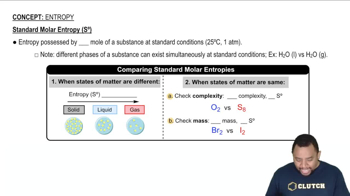
Molar Entropy

Molar entropy is a measure of the amount of disorder or randomness in a system per mole of substance. It reflects the number of accessible microstates for a given macrostate, with higher entropy indicating greater disorder. This concept is crucial for understanding thermodynamic processes and predicting how substances behave under varying conditions.
Video consigliato:
Percorso guidato
03:33
Standard Molar Entropy

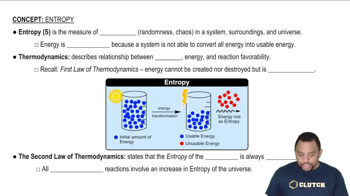
Temperature and Entropy Relationship

As temperature increases, the kinetic energy of particles in a substance also increases, leading to greater molecular motion. This heightened motion allows for more possible arrangements of particles, thereby increasing the molar entropy. The relationship between temperature and entropy is fundamental in thermodynamics, particularly in the context of the second law of thermodynamics.
Video consigliato:
Percorso guidato
02:46
Entropy in Thermodynamics

Second Law of Thermodynamics

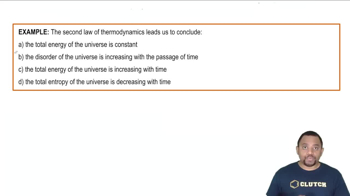
The second law of thermodynamics states that the total entropy of an isolated system can never decrease over time. It implies that natural processes tend to move towards a state of maximum disorder or entropy. Understanding this law helps explain why the molar entropy of substances generally increases with temperature, as systems evolve towards higher entropy states.
Video consigliato:
Percorso guidato
00:48
Second Law of Thermodynamics Example