Ch.19 - Free Energy & Thermodynamics
Tro - Chemistry: A Molecular Approach 6th Edition
Tro6th EditionChemistry: A Molecular ApproachISBN: 9780137832217Non è quello che usi tu?Cambia libro di testo
Capitolo 19, Problema 77b

Use data from Appendix IIB to calculate the equilibrium constants at 25 °C for each reaction. b. 2 H2S(g) ⇌ 2 H2(g) + S2(g)

Guida verificata passo dopo passo
1
Identify the reaction for which you need to calculate the equilibrium constant: \(2 \text{H}_2\text{S}(g) \rightleftharpoons 2 \text{H}_2(g) + \text{S}_2(g)\).
Use the standard Gibbs free energy change (\(\Delta G^\circ\)) values from Appendix IIB for each species involved in the reaction to calculate \(\Delta G^\circ_{\text{reaction}}\).
Apply the formula \(\Delta G^\circ = -RT \ln K\) to relate \(\Delta G^\circ\) to the equilibrium constant \(K\), where \(R\) is the universal gas constant (8.314 J/mol·K) and \(T\) is the temperature in Kelvin (298 K for 25 °C).
Rearrange the formula to solve for \(K\): \(K = e^{-\Delta G^\circ / RT}\).
Substitute the calculated \(\Delta G^\circ\) and the values of \(R\) and \(T\) into the equation to find the equilibrium constant \(K\).

Risposta video verificata per un problema simile:

Questa soluzione video è stata consigliata dai nostri tutor come utile per risolvere questo problema.
Durata del video:
7m

Concetti chiave

Ecco i concetti essenziali che devi comprendere per rispondere correttamente alla domanda.

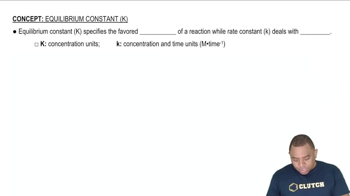
Equilibrium Constant (K)

The equilibrium constant (K) is a numerical value that expresses the ratio of the concentrations of products to reactants at equilibrium for a given chemical reaction at a specific temperature. It provides insight into the extent of a reaction; a large K indicates that products are favored, while a small K suggests that reactants are favored. The equilibrium constant is temperature-dependent and is calculated using the formula K = [products]^[coefficients] / [reactants]^[coefficients].
Video consigliato:
Percorso guidato
01:14
Equilibrium Constant K

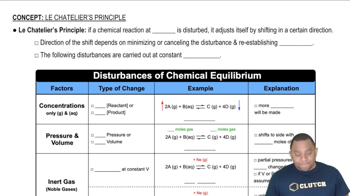
Le Chatelier's Principle

Le Chatelier's Principle states that if a dynamic equilibrium is disturbed by changing the conditions, the system will adjust itself to counteract the change and restore a new equilibrium. This principle helps predict how changes in concentration, pressure, or temperature will affect the position of equilibrium in a reaction. Understanding this concept is crucial for interpreting how shifts in conditions can influence the equilibrium constant.
Video consigliato:
Percorso guidato
07:32
Le Chatelier's Principle

Standard Conditions

Standard conditions refer to a set of specific conditions (usually 1 atm pressure and 25 °C) under which thermodynamic measurements are made. These conditions provide a reference point for calculating equilibrium constants and other thermodynamic properties. When calculating equilibrium constants, it is essential to ensure that the data used corresponds to these standard conditions to ensure accuracy and consistency in results.
Video consigliato:
Percorso guidato
01:10
Standard Reduction Potentials