

Ch.19 - Free Energy & Thermodynamics
Tro - Chemistry: A Molecular Approach 6th Edition
Tro6th EditionChemistry: A Molecular ApproachISBN: 9780137832217Non è quello che usi tu?Cambia libro di testo
Capitolo 19, Problema 27

Which of these processes is spontaneous? a. the combustion of natural gas b. the extraction of iron metal from iron ore c. a hot drink cooling to room temperature d. drawing heat energy from the ocean's surface to power a ship

Guida verificata passo dopo passo
1
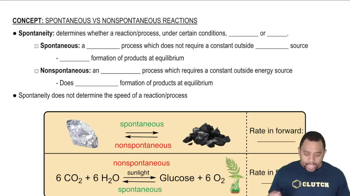
Step 1: Understand the concept of spontaneity. A spontaneous process is one that occurs naturally without any external influence. It is a process that, once started, continues by itself until it has reached a state of equilibrium.
Step 2: Apply this concept to each of the given processes. a. The combustion of natural gas is a spontaneous process because once ignited, it continues to burn without any external influence. b. The extraction of iron metal from iron ore is not a spontaneous process because it requires external energy in the form of heat to extract the metal from the ore. c. A hot drink cooling to room temperature is a spontaneous process because it naturally occurs as the drink loses heat to its surroundings. d. Drawing heat energy from the ocean's surface to power a ship is not a spontaneous process because it requires a mechanism to convert the heat energy into a form that can be used to power the ship.
Step 3: Therefore, the spontaneous processes among the given options are the combustion of natural gas and a hot drink cooling to room temperature.

Risposta video verificata per un problema simile:

Questa soluzione video è stata consigliata dai nostri tutor come utile per risolvere questo problema.
Durata del video:
1m

Concetti chiave

Ecco i concetti essenziali che devi comprendere per rispondere correttamente alla domanda.

Spontaneity in Chemical Processes

A spontaneous process is one that occurs naturally without the need for external energy input. It is driven by the increase in entropy, or disorder, of the system and its surroundings. Spontaneity is often assessed using Gibbs free energy, where a negative change indicates a spontaneous reaction at constant temperature and pressure.
Video consigliato:
Percorso guidato
04:20
Spontaneity of Processes

Entropy

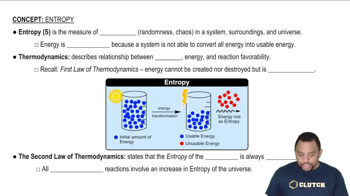
Entropy is a measure of the disorder or randomness in a system. In thermodynamics, processes that increase the total entropy of the universe are favored and tend to be spontaneous. For example, when a hot drink cools, the energy disperses into the surroundings, increasing entropy.
Video consigliato:
Percorso guidato
02:46
Entropy in Thermodynamics

Gibbs Free Energy

Gibbs free energy (G) is a thermodynamic potential that helps predict the spontaneity of a process at constant temperature and pressure. The change in Gibbs free energy (ΔG) is calculated as ΔG = ΔH - TΔS, where ΔH is the change in enthalpy, T is the temperature in Kelvin, and ΔS is the change in entropy. A negative ΔG indicates a spontaneous process.
Video consigliato:
Percorso guidato
01:51
Gibbs Free Energy of Reactions