

Ch.2 - Atoms & Elements
Tro - Chemistry: A Molecular Approach 6th Edition
Tro6th EditionChemistry: A Molecular ApproachISBN: 9780137832217Non è quello che usi tu?Cambia libro di testo
Capitolo 2, Problema 36

The mass ratio of sodium to fluorine in sodium fluoride is 1.21:1. A sample of sodium fluoride produces 45.1 g of sodium upon decomposition. How much fluorine (in grams) forms?

Guida verificata passo dopo passo
1
Identify the given mass ratio of sodium to fluorine in sodium fluoride, which is 1.21:1.
Understand that this ratio means for every 1.21 grams of sodium, there is 1 gram of fluorine.
Given that the sample produces 45.1 grams of sodium, set up a proportion to find the mass of fluorine: \( \frac{\text{mass of sodium}}{\text{mass of fluorine}} = \frac{1.21}{1} \).
Substitute the given mass of sodium into the proportion: \( \frac{45.1}{x} = \frac{1.21}{1} \), where \( x \) is the mass of fluorine.
Solve the proportion for \( x \) to find the mass of fluorine.

Risposta video verificata per un problema simile:

Questa soluzione video è stata consigliata dai nostri tutor come utile per risolvere questo problema.
Durata del video:
1m

Concetti chiave

Ecco i concetti essenziali che devi comprendere per rispondere correttamente alla domanda.

Stoichiometry

Stoichiometry is the branch of chemistry that deals with the quantitative relationships between the reactants and products in a chemical reaction. It allows chemists to predict the amounts of substances consumed and produced in a reaction based on balanced chemical equations. Understanding stoichiometry is essential for solving problems involving mass ratios and conversions between different substances.
Video consigliato:
Percorso guidato
01:16
Stoichiometry Concept

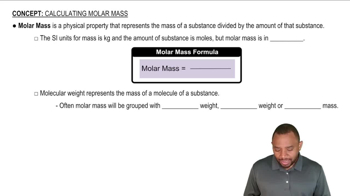
Molar Mass

Molar mass is the mass of one mole of a substance, typically expressed in grams per mole (g/mol). It is calculated by summing the atomic masses of all the atoms in a molecule. In the context of sodium fluoride (NaF), knowing the molar masses of sodium (Na) and fluorine (F) is crucial for determining the mass of fluorine produced when a specific mass of sodium is decomposed.
Video consigliato:
Percorso guidato
02:11
Molar Mass Concept

Mass Ratio

The mass ratio is a comparison of the mass of one substance to the mass of another substance in a compound. In sodium fluoride, the mass ratio of sodium to fluorine is given as 1.21:1, indicating that for every 1.21 grams of sodium, there is 1 gram of fluorine. This ratio is vital for calculating the amount of fluorine produced from a known mass of sodium, as it provides a direct relationship between the two elements.
Video consigliato:
Percorso guidato
02:14
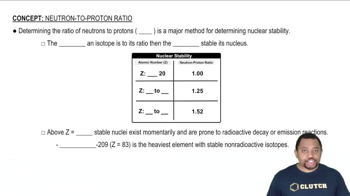
Neutron-Proton Ratio
Pratica correlata
Domanda del libro di testo

Upon decomposition, one sample of magnesium fluoride produces 1.65 kg of magnesium and 2.57 kg of fluorine. A second sample produces 2.72 kg of magnesium. How much fluorine (in grams) does the second sample produce?

2
views
Domanda del libro di testo

Palladium forms three different compounds with sulfur. The mass of sulfur per gram of palladium in each compound is listed here. Show that these masses are consistent with the law of multiple proportions. Compound Grams S per Gram Pd A 0.603 B 0.301 C 0.151

908
views
1
comments
Domanda del libro di testo

Sulfur and oxygen form both sulfur dioxide and sulfur trioxide. When samples of these are decomposed, the sulfur dioxide produces 3.49 g oxygen and 3.50 g sulfur, while the sulfur trioxide produces 6.75 g oxygen and 4.50 g sulfur. Calculate the mass of oxygen per gram of sulfur for each sample and show that these results are consistent with the law of multiple proportions.

2209
views
Domanda del libro di testo

Two different compounds containing osmium and oxygen have the following masses of oxygen per gram of osmium: 0.168 and 0.3369 g. Show that these amounts are consistent with the law of multiple proportions.

1321
views
4
rank
Domanda del libro di testo

Two samples of carbon tetrachloride are decomposed into their constituent elements. One sample produces 38.9 g of carbon and 448 g of chlorine, and the other sample produces 14.8 g of carbon and 134 g of chlorine. Are these results consistent with the law of definite proportions? Explain your answer.

1279
views
1
rank