Ch.2 - Atoms & Elements
Tro - Chemistry: A Molecular Approach 6th Edition
Tro6th EditionChemistry: A Molecular ApproachISBN: 9780137832217Non è quello che usi tu?Cambia libro di testo
Capitolo 2, Problema 55b

Write isotopic symbols in the form AZX for each isotope. b. the iron isotope with 30 neutrons

Guida verificata passo dopo passo
1
Identify the element: The element is iron, which has the chemical symbol 'Fe'.
Determine the atomic number (Z): Iron has an atomic number of 26, which means it has 26 protons.
Calculate the mass number (A): The mass number is the sum of protons and neutrons. Here, the isotope has 30 neutrons, so A = 26 (protons) + 30 (neutrons).
Write the isotopic symbol: Combine the mass number (A), atomic number (Z), and the chemical symbol (X) to write the isotopic symbol in the form A/Z X.
The isotopic symbol for the iron isotope with 30 neutrons is written as: ^{A}_{Z}Fe.

Risposta video verificata per un problema simile:

Questa soluzione video è stata consigliata dai nostri tutor come utile per risolvere questo problema.
Durata del video:
1m

Concetti chiave

Ecco i concetti essenziali che devi comprendere per rispondere correttamente alla domanda.

Isotopes

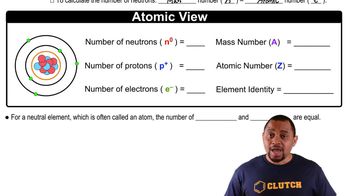
Isotopes are variants of a particular chemical element that have the same number of protons but different numbers of neutrons. This difference in neutron count results in varying atomic masses for the isotopes of the same element. For example, carbon has isotopes like carbon-12 and carbon-14, where the numbers indicate the total number of protons and neutrons.
Video consigliato:

Isotopic Notation

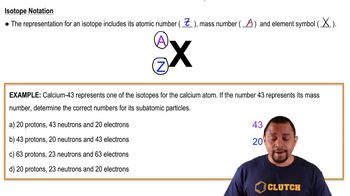
Isotopic notation is a way to represent isotopes using the format AZX, where 'A' is the mass number (total protons and neutrons), 'Z' is the atomic number (number of protons), and 'X' is the chemical symbol of the element. For instance, for an isotope of iron with 30 neutrons, the mass number would be 56 (26 protons + 30 neutrons), leading to the notation 56Fe.
Video consigliato:
Percorso guidato
03:57
Isotope Notation Example

Iron Isotopes

Iron has several isotopes, with the most common being iron-56, which has 26 protons and 30 neutrons. The presence of different isotopes can affect the physical and chemical properties of the element, including its stability and behavior in nuclear reactions. Understanding the specific isotopes of iron is crucial in fields like nuclear chemistry and geology.
Video consigliato: