Calculate ∆G°rxn and K for each reaction. b. The reaction of Cr3+(aq) and Cr(s) to form Cr2+(aq). [The electrode potential of Cr2+(aq) to Cr(s) is -0.91 V.]
Ch.20 - Electrochemistry

Tro6th EditionChemistry: A Molecular ApproachISBN: 9780137832217Non è quello che usi tu?Cambia libro di testo
Capitolo 20, Problema 129
A sample of impure tin of mass 0.535 g is dissolved in strong acid to give a solution of Sn2+. The solution is then titrated with a 0.0448 M solution of NO3–, which is reduced to NO(g). The equivalence point is reached upon the addition of 0.0344 L of the NO3– solution. Find the percent by mass of tin in the original sample, assuming that it contains no other reducing agents.
Guida verificata passo dopo passo1
Identify the balanced chemical equation for the reaction between Sn^{2+} and NO_3^-: Sn^{2+} + 2 NO_3^- + 4 H^+ \(\rightarrow\) Sn^{4+} + 2 NO + 2 H_2O.
Calculate the moles of NO_3^- used in the titration using the formula: \(\text{moles of NO}\)_3^- = \(\text{molarity}\) \(\times\) \(\text{volume in liters}\).
Use the stoichiometry of the balanced equation to find the moles of Sn^{2+} that reacted. According to the equation, 1 mole of Sn^{2+} reacts with 2 moles of NO_3^-.
Calculate the mass of tin (Sn) that reacted using the moles of Sn^{2+} and the molar mass of tin (118.71 \(\text{ g/mol}\)).
Determine the percent by mass of tin in the original sample using the formula: \(\text{percent by mass}\) = \(\left\)( \(\frac{\text{mass of tin}\)}{\(\text{mass of sample}\)} \(\right\)) \(\times\) 100.

Risposta video verificata per un problema simile:
Questa soluzione video è stata consigliata dai nostri tutor come utile per risolvere questo problema.
Durata del video:
8mConcetti chiave
Ecco i concetti essenziali che devi comprendere per rispondere correttamente alla domanda.
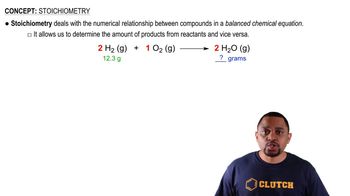
Stoichiometry
Stoichiometry is the calculation of reactants and products in chemical reactions. It involves using balanced chemical equations to determine the relationships between the amounts of substances consumed and produced. In this question, stoichiometry is essential for relating the moles of tin (Sn) to the moles of nitrate (NO3-) used in the titration, allowing for the determination of the mass of tin in the sample.
Video consigliato:
Percorso guidato
Stoichiometry Concept
Titration
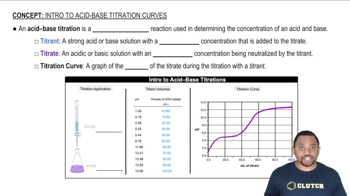
Titration is a quantitative analytical technique used to determine the concentration of a solute in a solution. It involves the gradual addition of a titrant to a solution until the reaction reaches its equivalence point, where stoichiometrically equivalent amounts of reactants have reacted. In this scenario, the titration of Sn2+ with NO3- allows for the calculation of the amount of tin present based on the volume and concentration of the nitrate solution used.
Video consigliato:
Percorso guidato
Acid-Base Titration
Percent by Mass
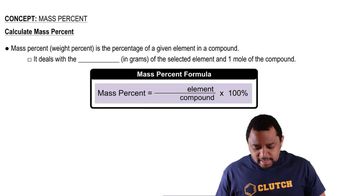
Percent by mass is a way to express the concentration of a component in a mixture or solution, calculated as the mass of the component divided by the total mass of the mixture, multiplied by 100. In this problem, after determining the mass of tin from the titration data, calculating the percent by mass involves comparing the mass of tin to the original mass of the impure sample, providing insight into the purity of the tin.
Video consigliato:
Percorso guidato
Mass Percent Calculation
Pratica correlata
Domanda del libro di testo
781
views
Domanda del libro di testo
A metal forms the fluoride MF3. Electrolysis of the molten fluo- ride by a current of 3.86 A for 16.2 minutes deposits 1.25 g of the metal. Calculate the molar mass of the metal.
736
views
Domanda del libro di testo
A current of 11.3 A is applied to 1.25 L of a solution of 0.552 M HBr converting some of the H+ to H2(g), which bubles out of solution. What is the pH of the solution after 73 minutes?
792
views
Domanda del libro di testo
To what pH should you adjust a standard hydrogen electrode to get an electrode potential of -0.122 V? (Assume that the partial pressure of hydrogen gas remains at 1 atm.)
707
views
Domanda del libro di testo
An MnO2(s)/Mn2+(aq) electrode in which the pH si 10.24 is prepared. Find the [Mn2+] necessary to lower the potential of the half-cell to 0.00 V (at 25°C)
889
views