
Ch.20 - Electrochemistry
Tro - Chemistry: A Molecular Approach 6th Edition
Tro6th EditionChemistry: A Molecular ApproachISBN: 9780137832217Non è quello che usi tu?Cambia libro di testo
Capitolo 20, Problema 82c

A voltaic cell consists of a Pb/Pb2+ half-cell and a Cu/Cu2+ half-cell at 25°C. The initial concentrations of Pb2+ and Cu2+ are 0.0500 M and 1.50 M, respectively. c. What are the concentrations of Pb2+ and Cu2+ when the cell potential falls to 0.35 V?

Guida verificata passo dopo passo
1
Identify the standard reduction potentials for both half-cells. For Pb, the reaction is Pb^2+ + 2e^- \(\rightarrow\) Pb, and for Cu, the reaction is Cu^2+ + 2e^- \(\rightarrow\) Cu.
Write the overall cell reaction by combining the two half-reactions. Make sure to balance the electrons in the half-reactions.
Use the Nernst equation to relate the cell potential to the ion concentrations. The Nernst equation is E = E^0 - (RT/nF) \(\ln\) Q, where E is the cell potential, E^0 is the standard cell potential, R is the gas constant, T is the temperature in Kelvin, n is the number of moles of electrons transferred, F is the Faraday constant, and Q is the reaction quotient.
Calculate the reaction quotient Q using the initial concentrations of Pb^2+ and Cu^2+. Q is given by the expression Q = [Pb^2+]/[Cu^2+]^2.
Solve the Nernst equation for the new concentrations of Pb^2+ and Cu^2+ when the cell potential is 0.35 V. Rearrange the equation to isolate the terms involving the concentrations and solve for the unknowns.

Risposta video verificata per un problema simile:

Questa soluzione video è stata consigliata dai nostri tutor come utile per risolvere questo problema.
Durata del video:
10m

Concetti chiave

Ecco i concetti essenziali che devi comprendere per rispondere correttamente alla domanda.

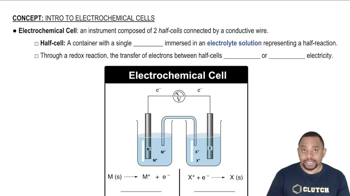
Electrochemical Cells

Electrochemical cells, such as voltaic cells, convert chemical energy into electrical energy through redox reactions. In a voltaic cell, oxidation occurs at the anode and reduction at the cathode, creating a flow of electrons that generates an electric current. Understanding the roles of the half-cells and the overall cell reaction is crucial for analyzing the cell's behavior under different conditions.
Video consigliato:
Percorso guidato
02:46
Electrochemical Cells

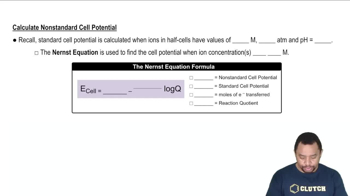
Nernst Equation

The Nernst equation relates the cell potential to the concentrations of the reactants and products in a redox reaction. It allows for the calculation of the cell potential at non-standard conditions, taking into account temperature and concentration changes. This equation is essential for determining how the concentrations of Pb2+ and Cu2+ will change as the cell operates and the potential decreases.
Video consigliato:
Percorso guidato
01:17
The Nernst Equation

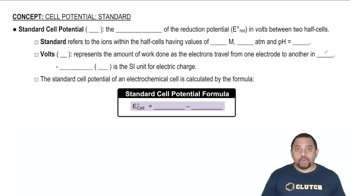
Standard Electrode Potentials

Standard electrode potentials are measured voltages that indicate the tendency of a half-cell to gain or lose electrons under standard conditions. Each half-cell has a specific standard potential, which is used to calculate the overall cell potential. Knowing the standard potentials for the Pb and Cu half-cells is necessary to understand how the cell operates and how the potential changes as the reaction proceeds.
Video consigliato:
Percorso guidato
01:27
Standard Cell Potential