Ch.20 - Electrochemistry
Tro - Chemistry: A Molecular Approach 6th Edition
Tro6th EditionChemistry: A Molecular ApproachISBN: 9780137832217Non è quello che usi tu?Cambia libro di testo
Capitolo 20, Problema 81b

A voltaic cell consists of a Zn/Zn2+ half-cell and a Ni/Ni2+ half-cell at 25 °C. The initial concentrations of Ni2+ and Zn2+ are 1.50 M and 0.100 M, respectively. b. What is the cell potential when the concentration of Ni2+ has fallen to 0.500 M?

Guida verificata passo dopo passo
1
Identify the half-reactions for the voltaic cell: Zn -> Zn^{2+} + 2e^- and Ni^{2+} + 2e^- -> Ni.
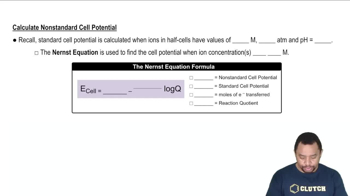
Write the Nernst equation for the cell potential: E = E^0 - \(\frac{RT}{nF}\) \(\ln\) Q, where Q is the reaction quotient.
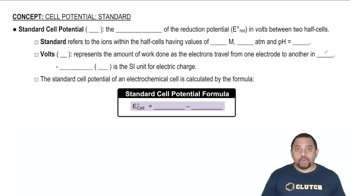
Calculate the standard cell potential (E^0) using standard reduction potentials: E^0_{cell} = E^0_{cathode} - E^0_{anode}.
Determine the reaction quotient (Q) using the concentrations: Q = \(\frac{[Zn^{2+}\)]}{[Ni^{2+}]}.
Substitute the values into the Nernst equation to find the cell potential at the given concentrations.

Risposta video verificata per un problema simile:

Questa soluzione video è stata consigliata dai nostri tutor come utile per risolvere questo problema.
Durata del video:
6m

Concetti chiave

Ecco i concetti essenziali che devi comprendere per rispondere correttamente alla domanda.

Nernst Equation

The Nernst Equation relates the cell potential of an electrochemical cell to the concentrations of the reactants and products. It is expressed as E = E° - (RT/nF) ln(Q), where E° is the standard cell potential, R is the gas constant, T is the temperature in Kelvin, n is the number of moles of electrons transferred, F is Faraday's constant, and Q is the reaction quotient. This equation allows us to calculate the cell potential under non-standard conditions.
Video consigliato:
Percorso guidato
01:17
The Nernst Equation

Cell Potential

Cell potential, or electromotive force (EMF), is the measure of the energy per unit charge available from a voltaic cell. It indicates the tendency of the cell to drive an electric current through an external circuit. The potential is influenced by the concentrations of the reactants and products, and it can change as the reaction proceeds, which is crucial for understanding how the cell operates over time.
Video consigliato:
Percorso guidato
01:27
Standard Cell Potential

Half-Cell Reactions

In a voltaic cell, half-cell reactions occur at the anode and cathode, where oxidation and reduction take place, respectively. For the Zn|Zn2+ half-cell, zinc is oxidized to Zn2+, while in the Ni|Ni2+ half-cell, Ni2+ is reduced to nickel. Understanding these half-cell reactions is essential for calculating the overall cell potential and determining how changes in concentration affect the cell's performance.
Video consigliato:
Percorso guidato
01:49
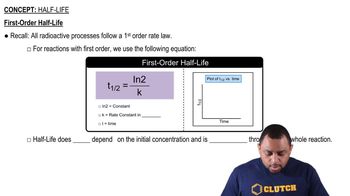
First-Order Half-Life
Pratica correlata
Domanda del libro di testo

An electrochemical cell is based on these two half-reactions:

Ox: Pb(s) → Pb2+(aq, 0.10 M) + 2 e–

Red: MnO4–(aq, 1.50 M) + 4 H+(aq, 2.0 M) + 3 e– → MnO2(s) + 2 H2O(l)

Calculate the cell potential at 25 °C.

3339
views

Domanda del libro di testo

An electrochemical cell is based on these two half-reactions:

Ox: Sn(s) → Sn2+(aq, 2.00 M) + 2 e–

Red: ClO2(g, 0.100 atm) + e– → ClO2–(aq, 2.00 M)

Calculate the cell potential at 25 °C.

2511
views
Domanda del libro di testo

A voltaic cell consists of a Pb/Pb2+ half-cell and a Cu/Cu2+ half-cell at 25°C. The initial concentrations of Pb2+ and Cu2+ are 0.0500 M and 1.50 M, respectively. b. What is the cell potential when the concentration of Cu2+ has fallen to 0.200 M?

1555
views
Domanda del libro di testo

A voltaic cell consists of a Zn/Zn2+ half-cell and a Ni/Ni2+ half-cell at 25 °C. The initial concentrations of Ni2+ and Zn2+ are 1.50 M and 0.100 M, respectively. c. What are the concentrations of Ni2+ and Zn2+ when the cell potential falls to 0.45 V?

1253
views
Domanda del libro di testo

A voltaic cell consists of a Pb/Pb2+ half-cell and a Cu/Cu2+ half-cell at 25°C. The initial concentrations of Pb2+ and Cu2+ are 0.0500 M and 1.50 M, respectively. a. What is the initial cell potential?

716
views
Domanda del libro di testo

A voltaic cell consists of a Zn/Zn2+ half-cell and a Ni/Ni2+ half-cell at 25 °C. The initial concentrations of Ni2+ and Zn2+ are 1.50 M and 0.100 M, respectively. a. What is the initial cell potential?

588
views