Ch.20 - Electrochemistry
Tro - Chemistry: A Molecular Approach 6th Edition
Tro6th EditionChemistry: A Molecular ApproachISBN: 9780137832217Non è quello che usi tu?Cambia libro di testo
Capitolo 20, Problema 78

A voltaic cell employs the redox reaction: 2 Fe3+(aq) + 3 Mg(s) → 2 Fe(s) + 3 Mg2+(aq). Calculate the cell potential at 25 °C under each set of conditions. a. standard conditions. b. [Fe3+] = 1.0 × 10^-3 M; [Mg2+] = 2.50 M. c. [Fe3+] = 2.00 M; [Mg2+] = 1.5 × 10^-3 M.

Guida verificata passo dopo passo
1
insert step 1: Identify the half-reactions and their standard reduction potentials.
insert step 2: Calculate the standard cell potential (E°cell) using the standard reduction potentials.
insert step 3: Use the Nernst equation to calculate the cell potential under non-standard conditions.
insert step 4: For part b, substitute the given concentrations into the Nernst equation and solve for the cell potential.
insert step 5: For part c, substitute the given concentrations into the Nernst equation and solve for the cell potential.

Concetti chiave

Ecco i concetti essenziali che devi comprendere per rispondere correttamente alla domanda.

Redox Reactions

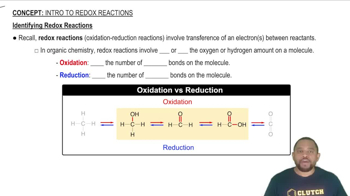
Redox reactions involve the transfer of electrons between two species, where one species is oxidized (loses electrons) and the other is reduced (gains electrons). In the given reaction, Fe3+ is reduced to Fe, while Mg is oxidized to Mg2+. Understanding the oxidation states and the flow of electrons is crucial for analyzing the cell's operation.
Video consigliato:
Percorso guidato
03:12
Identifying Redox Reactions

Cell Potential (E°)

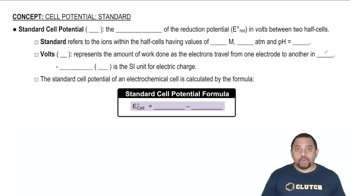
The cell potential, or electromotive force (EMF), is a measure of the voltage generated by a voltaic cell under specific conditions. It can be calculated using standard reduction potentials and the Nernst equation, which accounts for concentration changes. The standard cell potential is determined under standard conditions (1 M concentration, 1 atm pressure, and 25 °C).
Video consigliato:
Percorso guidato
01:27
Standard Cell Potential

Nernst Equation

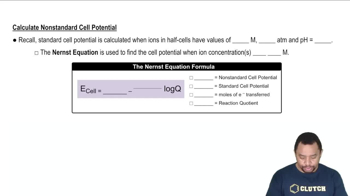
The Nernst equation relates the cell potential to the concentrations of the reactants and products in a redox reaction. It is expressed as E = E° - (RT/nF) ln(Q), where Q is the reaction quotient. This equation allows for the calculation of cell potential under non-standard conditions, making it essential for solving parts b and c of the question.
Video consigliato:
Percorso guidato
01:17
The Nernst Equation