Ch.20 - Electrochemistry
Tro - Chemistry: A Molecular Approach 6th Edition
Tro6th EditionChemistry: A Molecular ApproachISBN: 9780137832217Non è quello che usi tu?Cambia libro di testo
Capitolo 20, Problema 37a,b

Balance each redox reaction occurring in acidic aqueous solution. a. K(s) + Cr3+(aq) → Cr(s) + K+(aq) b. Al(s) + Fe2+(aq) → Al3+(aq) + Fe(s)

Guida verificata passo dopo passo
1
Identify the oxidation states of all elements in the reactants and products. Potassium (K) in its elemental form has an oxidation state of 0, Chromium (Cr) in Cr3+ has an oxidation state of +3, Chromium in Cr(s) has an oxidation state of 0, and Potassium in K+ has an oxidation state of +1.
Determine the changes in oxidation states to identify which elements are oxidized and which are reduced. Potassium (K) is oxidized as its oxidation state increases from 0 to +1. Chromium (Cr) is reduced as its oxidation state decreases from +3 to 0.
Write the half-reactions for both the oxidation and reduction processes. For oxidation: \( K(s) \rightarrow K^+(aq) + e^- \). For reduction: \( Cr^{3+}(aq) + 3e^- \rightarrow Cr(s) \).
Balance the electrons in the half-reactions. Since the reduction half-reaction involves gaining 3 electrons, multiply the oxidation half-reaction by 3 to balance the number of electrons lost and gained in both half-reactions.
Add the balanced half-reactions together and simplify to get the overall balanced equation in acidic solution: \( 3K(s) + Cr^{3+}(aq) \rightarrow 3K^+(aq) + Cr(s) \).

Risposta video verificata per un problema simile:

Questa soluzione video è stata consigliata dai nostri tutor come utile per risolvere questo problema.
Durata del video:
3m

Concetti chiave

Ecco i concetti essenziali che devi comprendere per rispondere correttamente alla domanda.

Redox Reactions

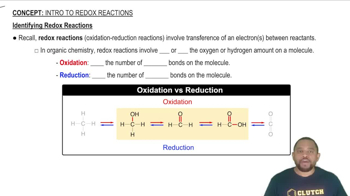
Redox reactions, or reduction-oxidation reactions, involve the transfer of electrons between two species. In these reactions, one species is oxidized (loses electrons) while another is reduced (gains electrons). Understanding the oxidation states of the elements involved is crucial for identifying which species undergo oxidation and reduction.
Video consigliato:
Percorso guidato
03:12
Identifying Redox Reactions

Balancing Redox Reactions

Balancing redox reactions requires ensuring that both mass and charge are conserved. This often involves separating the reaction into half-reactions: one for oxidation and one for reduction. In acidic solutions, hydrogen ions (H+) and water (H2O) are typically added to balance the equation, along with electrons to balance the charge.
Video consigliato:
Percorso guidato
01:04
Balancing Basic Redox Reactions

Acidic Aqueous Solutions

In acidic aqueous solutions, the presence of H+ ions influences the behavior of the reactants and products. The pH of the solution can affect the solubility and reactivity of certain species. When balancing redox reactions in such environments, it is essential to account for the H+ ions and any water produced or consumed in the reaction.
Video consigliato:
Percorso guidato
01:11
Types of Aqueous Solutions