Ch.20 - Electrochemistry
Tro - Chemistry: A Molecular Approach 6th Edition
Tro6th EditionChemistry: A Molecular ApproachISBN: 9780137832217Non è quello che usi tu?Cambia libro di testo
Capitolo 20, Problema 58

Determine whether or not each redox reaction occurs spontaneously in the forward direction.
a. Ca2+(aq) + Zn(s) → Ca(s) + Zn2+(aq)
b. 2 Ag+(aq) + Ni(s) → 2 Ag(s) + Ni2+(aq)
c. Fe(s) + Mn2+(aq) → Fe2+(aq) + Mn(s)
d. 2 Al(s) + 3 Pb2+(aq) → 2 Al3+(aq) + 3 Pb(s)

Guida verificata passo dopo passo
1
Identify the oxidation and reduction half-reactions. In this case, silver ions (Ag+) are reduced to silver metal (Ag), and nickel metal (Ni) is oxidized to nickel ions (Ni2+).
Write the half-reactions separately. For reduction: Ag+ + e- → Ag. For oxidation: Ni → Ni2+ + 2e-.
Check the standard reduction potentials for each half-reaction. The standard reduction potential for Ag+ to Ag is +0.80 V, and for Ni to Ni2+ it is -0.25 V.
Calculate the standard cell potential (E°cell) for the reaction by subtracting the standard reduction potential of the anode (oxidation) from the cathode (reduction). E°cell = E°cathode - E°anode.
Determine the spontaneity of the reaction. If E°cell is positive, the reaction is spontaneous in the forward direction; if it is negative, the reaction is non-spontaneous.

Risposta video verificata per un problema simile:

Questa soluzione video è stata consigliata dai nostri tutor come utile per risolvere questo problema.
Durata del video:
4m

Concetti chiave

Ecco i concetti essenziali che devi comprendere per rispondere correttamente alla domanda.

Redox Reactions

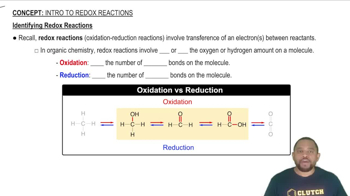
Redox reactions, or reduction-oxidation reactions, involve the transfer of electrons between two species. In these reactions, one species is oxidized (loses electrons) while the other is reduced (gains electrons). Understanding the oxidation states of the elements involved is crucial for identifying which species undergo these changes.
Video consigliato:
Percorso guidato
03:12
Identifying Redox Reactions

Standard Electrode Potentials

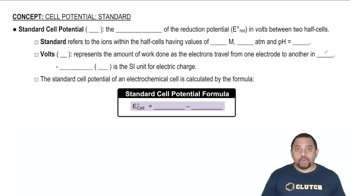
Standard electrode potentials (E°) are measured values that indicate the tendency of a species to be reduced. Each half-reaction has a specific E° value, and the overall spontaneity of a redox reaction can be determined by calculating the cell potential (E°cell) using the formula E°cell = E°(reduction) - E°(oxidation). A positive E°cell indicates that the reaction is spontaneous in the forward direction.
Video consigliato:
Percorso guidato
01:27
Standard Cell Potential

Spontaneity of Reactions

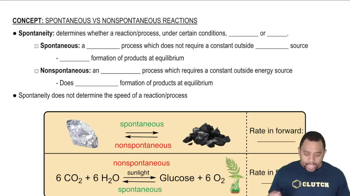
The spontaneity of a reaction refers to its ability to occur without external intervention. In the context of redox reactions, spontaneity can be assessed through Gibbs free energy (ΔG). A negative ΔG corresponds to a spontaneous reaction, which can be related to the cell potential; specifically, ΔG = -nFE°cell, where n is the number of moles of electrons transferred and F is Faraday's constant.
Video consigliato:
Percorso guidato
04:20
Spontaneity of Processes