Ch.20 - Electrochemistry
Tro - Chemistry: A Molecular Approach 6th Edition
Tro6th EditionChemistry: A Molecular ApproachISBN: 9780137832217Non è quello che usi tu?Cambia libro di testo
Capitolo 20, Problema 104

Silver can be electroplated at the cathode of an electrolysis cell by the half-reaction: Ag+(aq) + e– → Ag(s) What mass of silver would plate onto the cathode if a current of 6.8 A flowed through the cell for 72 min?

Guida verificata passo dopo passo
1
First, we need to understand the relationship between current, time, and the amount of substance produced in an electrolysis reaction. This is given by Faraday's laws of electrolysis. According to the first law, the mass of a substance produced at an electrode during electrolysis is directly proportional to the quantity of electricity that passes through the electrolyte. The quantity of electricity can be calculated by multiplying the current (in amperes) by the time (in seconds).
Next, we need to convert the time given in minutes to seconds because the SI unit of time in this context is the second. This can be done by multiplying the time in minutes by 60.
Then, we calculate the total charge passed through the cell by multiplying the current by the time in seconds. This gives us the total charge in coulombs.
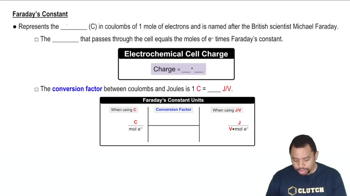
Next, we need to calculate the number of moles of electrons transferred. This can be done by dividing the total charge by the charge of one mole of electrons, which is known as Faraday's constant (approximately 96485 C/mol).
Finally, we can calculate the mass of silver plated out. From the half-reaction, we can see that one mole of silver ions (Ag+) reacts with one mole of electrons to form one mole of silver atoms (Ag). Therefore, the number of moles of silver plated out is equal to the number of moles of electrons transferred. The mass can then be calculated by multiplying the number of moles by the molar mass of silver (approximately 107.87 g/mol).

Risposta video verificata per un problema simile:

Questa soluzione video è stata consigliata dai nostri tutor come utile per risolvere questo problema.
Durata del video:
4m

Concetti chiave

Ecco i concetti essenziali che devi comprendere per rispondere correttamente alla domanda.

Electrolysis

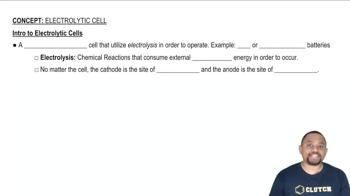
Electrolysis is a chemical process that uses electrical energy to drive a non-spontaneous reaction. In this process, an electric current is passed through an electrolyte, causing the movement of ions towards the electrodes. At the cathode, reduction occurs, where cations gain electrons and are deposited as solid metal, as seen in the silver plating reaction.
Video consigliato:
Percorso guidato
01:21
The Electrolytic Cell

Faraday's Laws of Electrolysis

Faraday's Laws of Electrolysis quantify the relationship between the amount of substance deposited during electrolysis and the electric charge passed through the cell. The first law states that the mass of a substance deposited is directly proportional to the total electric charge. This relationship is crucial for calculating the mass of silver that can be plated based on the current and time.
Video consigliato:
Percorso guidato
01:40
Faraday's Constant in Electrochemistry

Current and Charge

Current, measured in amperes (A), is the flow of electric charge per unit time. To find the total charge (Q) that flows through the electrolysis cell, the formula Q = I × t is used, where I is the current and t is the time in seconds. This total charge is essential for determining how much silver can be deposited at the cathode during the electrolysis process.
Video consigliato: