Ch.21 - Radioactivity & Nuclear Chemistry
Tro - Chemistry: A Molecular Approach 6th Edition
Tro6th EditionChemistry: A Molecular ApproachISBN: 9780137832217Non è quello che usi tu?Cambia libro di testo
Capitolo 21, Problema 37d

Determine whether or not each nuclide is likely to be stable. State your reasons. d. Sn-134

Guida verificata passo dopo passo
1
Identify the atomic number of the element Sn (Tin), which is 50.
Determine the number of neutrons in Sn-134 by subtracting the atomic number from the mass number: 134 - 50 = 84 neutrons.
Check the neutron-to-proton (N/Z) ratio: N = 84, Z = 50, so N/Z = 84/50.
Compare the N/Z ratio to the stability range for medium-sized nuclei, which is typically around 1 to 1.5.
Consider the magic numbers, which are numbers of protons or neutrons that confer extra stability to the nucleus. Check if 50 (protons) or 84 (neutrons) is a magic number.

Risposta video verificata per un problema simile:

Questa soluzione video è stata consigliata dai nostri tutor come utile per risolvere questo problema.
Durata del video:
1m

Concetti chiave

Ecco i concetti essenziali che devi comprendere per rispondere correttamente alla domanda.

Nuclear Stability

Nuclear stability refers to the ability of a nucleus to remain intact without undergoing radioactive decay. Stable nuclides have a balanced ratio of protons to neutrons, which helps to counteract the repulsive forces between protons. Generally, nuclides with a neutron-to-proton ratio close to 1:1 are more likely to be stable, while those with significantly higher or lower ratios tend to be unstable.
Video consigliato:
Percorso guidato
03:29
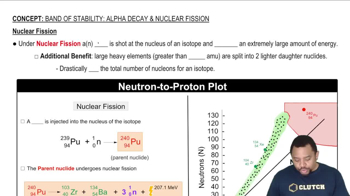
Band of Stability: Nuclear Fission

Isotopes and Nuclides

Isotopes are variants of a chemical element that have the same number of protons but different numbers of neutrons. Each isotope of an element is referred to as a nuclide, which is characterized by its mass number (total number of protons and neutrons). Understanding the specific isotopes of an element, such as Sn-134, is crucial for assessing their stability and potential for decay.
Video consigliato:

Decay Modes

Decay modes are the processes by which unstable nuclides transform into more stable forms, often resulting in the emission of radiation. Common decay modes include alpha decay, beta decay, and gamma decay. The likelihood of a nuclide undergoing a specific decay mode can be influenced by its neutron-to-proton ratio and overall energy state, which are essential for predicting the stability of nuclides like Sn-134.
Video consigliato: