
Ch.21 - Radioactivity & Nuclear Chemistry
Tro - Chemistry: A Molecular Approach 6th Edition
Tro6th EditionChemistry: A Molecular ApproachISBN: 9780137832217Non è quello che usi tu?Cambia libro di testo
Capitolo 21, Problema 55

An ancient skull has a carbon-14 decay rate of 0.85 disintegrations per minute per gram of carbon (0.85 dis/min/g C). How old is the skull? (Assume that living organisms have a carbon-14 decay rate of 15.3 dis/min/g C and that carbon-14 has a half-life of 5715 years.)

Guida verificata passo dopo passo
1
Identify the initial and final decay rates: The initial decay rate for living organisms is 15.3 dis/min/g C, and the final decay rate for the skull is 0.85 dis/min/g C.
Use the decay formula: The decay of carbon-14 can be described by the formula \( N = N_0 e^{-\lambda t} \), where \( N \) is the final decay rate, \( N_0 \) is the initial decay rate, \( \lambda \) is the decay constant, and \( t \) is the time elapsed.
Calculate the decay constant \( \lambda \): The decay constant is related to the half-life \( t_{1/2} \) by the formula \( \lambda = \frac{\ln(2)}{t_{1/2}} \). Substitute the given half-life of 5715 years to find \( \lambda \).
Rearrange the decay formula to solve for \( t \): \( t = \frac{\ln(N_0/N)}{\lambda} \). Substitute the values for \( N_0 \), \( N \), and \( \lambda \) into this equation.
Calculate \( t \): This will give you the age of the skull in years.

Concetti chiave

Ecco i concetti essenziali che devi comprendere per rispondere correttamente alla domanda.

Carbon-14 Dating

Carbon-14 dating is a radiometric dating method used to determine the age of organic materials by measuring the amount of carbon-14 they contain. Living organisms maintain a constant ratio of carbon-14 to carbon-12 while alive, but upon death, carbon-14 begins to decay at a known rate, allowing scientists to estimate the time since death based on the remaining carbon-14.
Video consigliato:
Percorso guidato
03:48
3 and 4 Carbon Alkyls

Half-Life

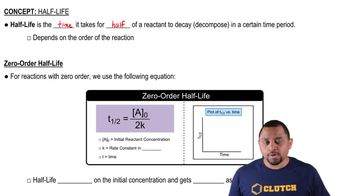
The half-life of a radioactive isotope is the time required for half of the isotope in a sample to decay. For carbon-14, this half-life is approximately 5715 years. Understanding half-life is crucial for calculating the age of a sample, as it provides a consistent measure of decay over time.
Video consigliato:
Percorso guidato
02:17
Zero-Order Half-life

Decay Rate

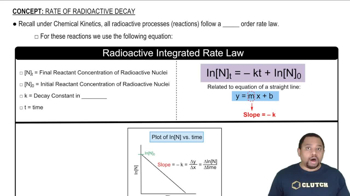
The decay rate of a radioactive substance indicates how quickly it disintegrates over time, typically expressed in disintegrations per minute per gram. In this question, the decay rates of the ancient skull and living organisms are compared to determine the age of the skull by calculating how many half-lives have passed since the organism's death.
Video consigliato:
Percorso guidato
03:00
Rate of Radioactive Decay