A typical home uses approximately 1.0⨉103 kWh of energy per month. If the energy came from a nuclear reaction, what mass would have to be converted to energy per year to meet the energy needs of the home?
Ch.21 - Radioactivity & Nuclear Chemistry

Tro6th EditionChemistry: A Molecular ApproachISBN: 9780137832217Non è quello che usi tu?Cambia libro di testo
Capitolo 21, Problema 72
Calculate the quantity of energy produced per mole of U-235 (atomic mass = 235.043922 amu) for the neutron-induced fission of U-235 to produce Te-137 (atomic mass = 136.9253 amu) and Zr-97 (atomic mass = 96.910950 amu) (discussed in Problem 58).
Guida verificata passo dopo passo1
Identify the nuclear reaction: U-235 undergoes fission when it absorbs a neutron, resulting in the formation of Te-137, Zr-97, and additional neutrons.
Calculate the mass defect: Determine the difference in mass between the reactants (U-235 and a neutron) and the products (Te-137, Zr-97, and additional neutrons).
Convert the mass defect to energy: Use Einstein's equation, \( E = \Delta m c^2 \), where \( \Delta m \) is the mass defect and \( c \) is the speed of light, to find the energy released per fission event.
Determine the energy per mole: Multiply the energy per fission event by Avogadro's number (\( 6.022 \times 10^{23} \) mol\(^{-1}\)) to find the energy produced per mole of U-235.
Summarize the process: The energy produced per mole of U-235 is the result of converting the mass defect into energy, as described by Einstein's equation, and scaling it to a molar quantity using Avogadro's number.

Risposta video verificata per un problema simile:
Questa soluzione video è stata consigliata dai nostri tutor come utile per risolvere questo problema.
Durata del video:
6mConcetti chiave
Ecco i concetti essenziali che devi comprendere per rispondere correttamente alla domanda.
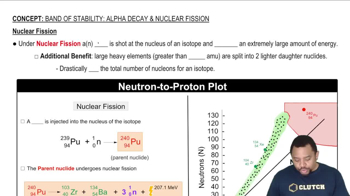
Nuclear Fission
Nuclear fission is a process in which a heavy nucleus, such as uranium-235, splits into two smaller nuclei, along with the release of energy and neutrons. This reaction can be initiated by the absorption of a neutron, leading to a chain reaction that can produce significant amounts of energy, which is the principle behind nuclear reactors and atomic bombs.
Video consigliato:
Percorso guidato
Band of Stability: Nuclear Fission
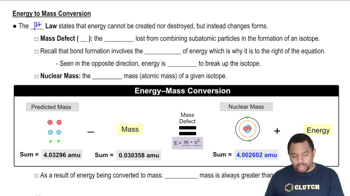
Mass-Energy Equivalence
Mass-energy equivalence, expressed by Einstein's equation E=mc², states that mass can be converted into energy and vice versa. In nuclear reactions, the mass of the products is often less than the mass of the reactants, and this 'missing' mass is converted into energy, which can be calculated to determine the energy released during fission.
Video consigliato:
Percorso guidato
Energy to Mass Conversion
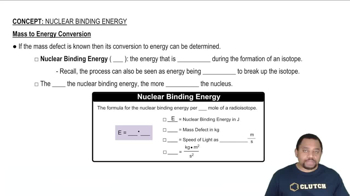
Binding Energy
Binding energy is the energy required to disassemble a nucleus into its constituent protons and neutrons. It is a measure of the stability of a nucleus; higher binding energy indicates a more stable nucleus. In fission, the binding energy of the products is greater than that of the reactants, resulting in the release of energy during the reaction.
Video consigliato:
Percorso guidato
Nuclear Binding Energy
Pratica correlata
Domanda del libro di testo
669
views
2
rank
Domanda del libro di testo
Calculate the mass defect and nuclear binding energy per nucleon of each nuclide. a. Li-7 (atomic mass = 7.016003 amu)
1438
views
Domanda del libro di testo
A 75-kg human has a dose of 32.8 rad of radiation. How much energy is absorbed by the person's body? Compare this energy to the amount of energy absorbed by the person's body if he or she jumped from a chair to the floor (assume that the chair is 0.50 m from the ground and that all of the energy from the fall is absorbed by the person).
805
views
Domanda del libro di testo
Calculate the quantity of energy produced per gram of U-235 (atomic mass = 235.043922 amu) for the neutron-induced fission of U-235 to form Xe-144 (atomic mass = 143.9385 amu) and Sr-90 (atomic mass = 89.907738 amu) (discussed in Problem 57).
1943
views
1
rank