Ch.21 - Radioactivity & Nuclear Chemistry
Tro - Chemistry: A Molecular Approach 6th Edition
Tro6th EditionChemistry: A Molecular ApproachISBN: 9780137832217Non è quello che usi tu?Cambia libro di testo
Capitolo 21, Problema 42c

Predict a likely mode of decay for each unstable nuclide. c. In-132

Guida verificata passo dopo passo
1
Identify the atomic number and mass number of the nuclide In-132. Indium (In) has an atomic number of 49.
Determine the neutron number by subtracting the atomic number from the mass number: Neutron number = 132 - 49.
Compare the neutron-to-proton ratio of In-132 to the stable isotopes of indium. A high neutron-to-proton ratio suggests beta decay.
Consider the position of In-132 on the chart of nuclides. Nuclides with a high neutron-to-proton ratio typically undergo beta decay to convert a neutron into a proton.
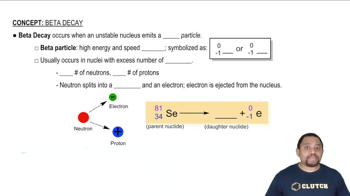
Conclude that the likely mode of decay for In-132 is beta decay, where a neutron is converted into a proton, emitting a beta particle (electron) and an antineutrino.

Risposta video verificata per un problema simile:

Questa soluzione video è stata consigliata dai nostri tutor come utile per risolvere questo problema.
Durata del video:
1m

Concetti chiave

Ecco i concetti essenziali che devi comprendere per rispondere correttamente alla domanda.

Nuclear Decay

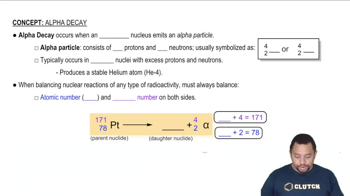
Nuclear decay refers to the process by which an unstable atomic nucleus loses energy by emitting radiation. This can occur through various modes, including alpha decay, beta decay, and gamma decay, each characterized by the type of particle or energy released. Understanding the specific decay mode is crucial for predicting the behavior of unstable nuclides.
Video consigliato:

Isotopes and Stability

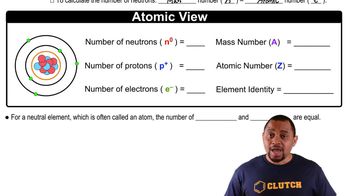
Isotopes are variants of a chemical element that have the same number of protons but different numbers of neutrons. The stability of an isotope depends on the ratio of neutrons to protons; an imbalance can lead to instability and subsequent decay. For example, Indium-132 (In-132) is an isotope that may undergo decay due to its neutron-to-proton ratio.
Video consigliato:

Decay Chains

Decay chains are sequences of decays that occur when a radioactive nuclide transforms into a series of other nuclides until a stable one is reached. Each step in the chain can involve different decay modes, and understanding these chains is essential for predicting the final products of a given unstable nuclide, such as In-132.
Video consigliato: