Ch.21 - Radioactivity & Nuclear Chemistry

Tro6th EditionChemistry: A Molecular ApproachISBN: 9780137832217
Non è quello che usi tu?Cambia libro di testoScegli un libro di testo diverso
TOC.tableOfContents
- Ch.1 - Matter, Measurement & Problem Solving118
- Ch.2 - Atoms & Elements106
- Ch.3 - Molecules and Compounds131
- Ch.4 - Chemical Reactions and Chemical Quantities56
- Ch.5 - Introduction to Solutions and Aqueous Solutions82
- Ch.6 - Gases114
- Ch.7 - Thermochemistry96
- Ch.8 - The Quantum-Mechanical Model of the Atom60
- Ch.9 - Periodic Properties of the Elements90
- Ch.10 - Chemical Bonding I: The Lewis Model89
- Ch.11 - Chemical Bonding II: Molecular Shapes, VSEPR & MO Theory85
- Ch.12 - Liquids, Solids & Intermolecular Forces51
- Ch.13 - Solids & Modern Materials47
- Ch.14 - Solutions90
- Ch.15 - Chemical Kinetics115
- Ch.16 - Chemical Equilibrium68
- Ch.17 - Acids and Bases136
- Ch.18 - Aqueous Ionic Equilibrium153
- Ch.19 - Free Energy & Thermodynamics93
- Ch.20 - Electrochemistry106
- Ch.21 - Radioactivity & Nuclear Chemistry74
- Ch.22 - Organic Chemistry140
Tro6th EditionChemistry: A Molecular ApproachISBN: 9780137832217Non è quello che usi tu?Cambia libro di testo

Capitolo 21, Problema 100
The nuclide 18F decays by both electron capture and β+ decay. Find the difference in the energy released by these two processes. The atomic masses are 18F = 18.000950 and 18O = 17.9991598.
 Guida verificata passo dopo passo
1
Identify the two decay processes: electron capture and beta-plus (β+) decay.
For electron capture, calculate the energy released using the mass difference between the parent nuclide (18F) and the daughter nuclide (18O).
For β+ decay, calculate the energy released by considering the mass difference between the parent nuclide (18F) and the daughter nuclide (18O), and account for the mass of the emitted positron.
Use the equation E = Δm * c^2 to convert the mass difference to energy, where Δm is the mass difference and c is the speed of light.
Find the difference in energy released between the two processes by subtracting the energy calculated for electron capture from the energy calculated for β+ decay.
Risposta video verificata per un problema simile:
Questa soluzione video è stata consigliata dai nostri tutor come utile per risolvere questo problema.

Durata del video:
6mConcetti chiave
Ecco i concetti essenziali che devi comprendere per rispondere correttamente alla domanda.
Nuclear Decay Processes
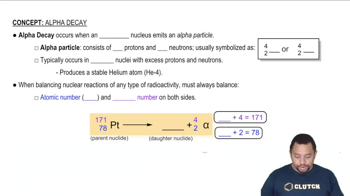
Nuclear decay processes, such as electron capture and beta-plus (β+) decay, involve the transformation of unstable nuclei into more stable forms. In electron capture, an electron is absorbed by a proton, converting it into a neutron and emitting a neutrino. In β+ decay, a proton is transformed into a neutron, emitting a positron and a neutrino. Understanding these processes is crucial for analyzing the energy changes associated with nuclear reactions.
Video consigliato:
Percorso guidato
 03:53
03:53
Alpha Decay
Energy Release in Nuclear Reactions
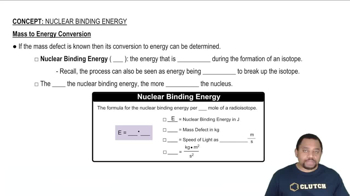
The energy released during nuclear reactions is determined by the mass difference between the reactants and products, as described by Einstein's equation E=mc². When a nuclide undergoes decay, the mass of the resulting particles is often less than that of the original nuclide, and this mass defect is converted into energy. Calculating the energy released in different decay processes allows for a comparison of their efficiencies and impacts.
Video consigliato:
Percorso guidato
 02:06
02:06Nuclear Binding Energy
Atomic Mass and Mass Defect
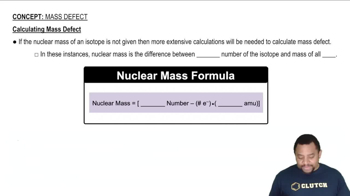
Atomic mass is a measure of the mass of an atom, typically expressed in atomic mass units (amu). The mass defect refers to the difference between the total mass of the individual nucleons and the actual mass of the nucleus, which accounts for the binding energy that holds the nucleus together. In decay calculations, knowing the atomic masses of the involved nuclides is essential for determining the mass defect and, consequently, the energy released during the decay.
Video consigliato:
Percorso guidato
 00:55
00:55Calculating Mass Defect
Pratica correlata