Ch.22 - Organic Chemistry
Tro - Chemistry: A Molecular Approach 6th Edition
Tro6th EditionChemistry: A Molecular ApproachISBN: 9780137832217Non è quello che usi tu?Cambia libro di testo
Capitolo 22, Problema 82c

Draw the structure of each carboxylic acid or ester. c. 3-ethylheptanoic acid

Guida verificata passo dopo passo
1
Identify the parent chain: The name '3-ethylheptanoic acid' indicates that the parent chain is 'heptanoic acid', which is a seven-carbon carboxylic acid.
Number the carbon atoms: Start numbering the carbon atoms from the carboxylic acid end, which is the most oxidized end, to ensure the carboxyl group is on carbon 1.
Locate the substituent: The '3-ethyl' indicates that there is an ethyl group (C2H5) attached to the third carbon of the heptanoic acid chain.
Draw the structure: Begin with the seven-carbon chain for heptanoic acid, add the carboxyl group (COOH) at the first carbon, and attach the ethyl group to the third carbon.
Verify the structure: Ensure that the structure has a total of seven carbons in the main chain, with the carboxyl group at one end and the ethyl group on the third carbon.

Risposta video verificata per un problema simile:

Questa soluzione video è stata consigliata dai nostri tutor come utile per risolvere questo problema.
Durata del video:
4m

Concetti chiave

Ecco i concetti essenziali che devi comprendere per rispondere correttamente alla domanda.

Carboxylic Acids

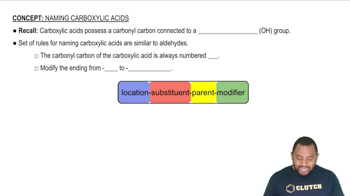
Carboxylic acids are organic compounds characterized by the presence of one or more carboxyl groups (-COOH). This functional group consists of a carbon atom double-bonded to an oxygen atom and single-bonded to a hydroxyl group (OH). Carboxylic acids are known for their acidic properties and are commonly found in various biological and industrial processes.
Video consigliato:
Percorso guidato
00:55
Rules for Naming Carboxylic Acids

Ester Functional Group

Esters are derived from carboxylic acids and are formed when the hydroxyl group of the carboxylic acid is replaced by an alkoxy group (-O-R). The general structure of an ester can be represented as RCOOR', where R and R' are hydrocarbon chains. Esters are often characterized by their pleasant fragrances and are commonly used in flavorings and fragrances.
Video consigliato:
Percorso guidato
01:32
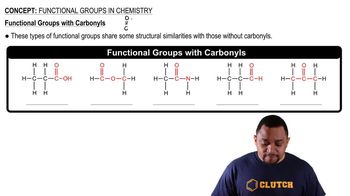
Carbonyl Functional Groups

Structural Representation

Structural representation in chemistry involves depicting the arrangement of atoms within a molecule, including bonds and functional groups. For carboxylic acids and esters, this includes showing the carbon backbone and the specific functional groups. Understanding how to draw these structures is essential for visualizing molecular interactions and predicting chemical behavior.
Video consigliato:
Percorso guidato
01:42
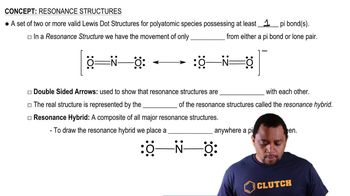
Resonance Structures