Ch.3 - Molecules and Compounds
Tro - Chemistry: A Molecular Approach 6th Edition
Tro6th EditionChemistry: A Molecular ApproachISBN: 9780137832217Non è quello che usi tu?Cambia libro di testo
Capitolo 3, Problema 96b

A chemist decomposes samples of several compounds; the masses of their constituent elements are listed. Calculate the empirical formula for each compound. b. 2.677 g Ba, 3.115 g Br

Guida verificata passo dopo passo
1
Determine the moles of each element by dividing the given mass by the atomic mass of the element. For barium (Ba), use its atomic mass of approximately 137.33 g/mol. For bromine (Br), use its atomic mass of approximately 79.90 g/mol.
Calculate the moles of Ba: \( \text{moles of Ba} = \frac{2.677 \text{ g}}{137.33 \text{ g/mol}} \).
Calculate the moles of Br: \( \text{moles of Br} = \frac{3.115 \text{ g}}{79.90 \text{ g/mol}} \).
Determine the simplest whole number ratio of moles of Ba to moles of Br by dividing each by the smallest number of moles calculated.
Write the empirical formula using the whole number ratio obtained from the previous step, with Ba and Br as the elements in the formula.

Risposta video verificata per un problema simile:

Questa soluzione video è stata consigliata dai nostri tutor come utile per risolvere questo problema.
Durata del video:
2m

Concetti chiave

Ecco i concetti essenziali che devi comprendere per rispondere correttamente alla domanda.

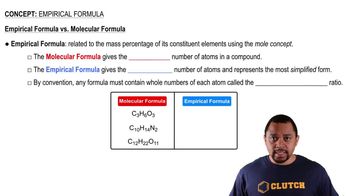
Empirical Formula

The empirical formula of a compound represents the simplest whole-number ratio of the elements present in that compound. It is derived from the mass of each element in a sample, which is converted to moles, allowing for the determination of the ratio of the elements. This formula does not provide information about the actual number of atoms in a molecule but rather the relative proportions of each element.
Video consigliato:
Percorso guidato
02:26
Empirical vs Molecular Formula

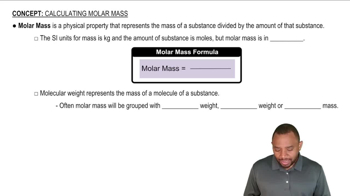
Molar Mass

Molar mass is the mass of one mole of a substance, typically expressed in grams per mole (g/mol). It is calculated by summing the atomic masses of all the atoms in a compound's molecular formula. Understanding molar mass is essential for converting between grams and moles, which is a critical step in determining the empirical formula from mass data.
Video consigliato:
Percorso guidato
02:11
Molar Mass Concept

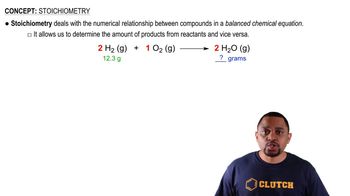
Stoichiometry

Stoichiometry is the area of chemistry that deals with the relationships between the quantities of reactants and products in chemical reactions. It involves using balanced chemical equations to calculate the amounts of substances consumed and produced. In the context of finding empirical formulas, stoichiometry helps in determining the mole ratios of the elements based on their masses.
Video consigliato:
Percorso guidato
01:16
Stoichiometry Concept