Ch.3 - Molecules and Compounds
Tro - Chemistry: A Molecular Approach 6th Edition
Tro6th EditionChemistry: A Molecular ApproachISBN: 9780137832217Non è quello che usi tu?Cambia libro di testo
Capitolo 3, Problema 133

A compound of molar mass 177 g/mol contains only carbon, hydrogen, bromine, and oxygen. Analysis reveals that the compound contains eight times as much carbon as hydrogen by mass. Find the molecular formula.

Guida verificata passo dopo passo
1
Identify the elements present in the compound: carbon (C), hydrogen (H), bromine (Br), and oxygen (O).
Let the mass of hydrogen be x grams. According to the problem, the mass of carbon is 8x grams.
Express the mass of each element in terms of moles: \( \text{moles of C} = \frac{8x}{12.01} \), \( \text{moles of H} = \frac{x}{1.008} \).
Assume the remaining mass is due to bromine and oxygen. Let the mass of bromine be y grams and the mass of oxygen be z grams. The total mass is 177 grams, so \( 8x + x + y + z = 177 \).
Use the molar masses to express the moles of bromine and oxygen: \( \text{moles of Br} = \frac{y}{79.90} \), \( \text{moles of O} = \frac{z}{16.00} \).

Risposta video verificata per un problema simile:

Questa soluzione video è stata consigliata dai nostri tutor come utile per risolvere questo problema.
Durata del video:
4m

Concetti chiave

Ecco i concetti essenziali che devi comprendere per rispondere correttamente alla domanda.

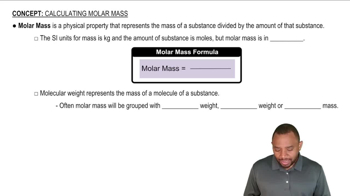
Molar Mass

Molar mass is the mass of one mole of a substance, typically expressed in grams per mole (g/mol). It is calculated by summing the atomic masses of all the atoms in a molecule. Understanding molar mass is crucial for determining the number of moles in a given mass of a compound, which is essential for stoichiometric calculations in chemistry.
Video consigliato:
Percorso guidato
02:11
Molar Mass Concept

Mass Ratio

The mass ratio is a comparison of the mass of one element to the mass of another element in a compound. In this question, the mass ratio indicates that the mass of carbon is eight times that of hydrogen. This relationship allows us to set up equations to find the relative amounts of each element in the compound, which is vital for deriving the molecular formula.
Video consigliato:
Percorso guidato
02:14
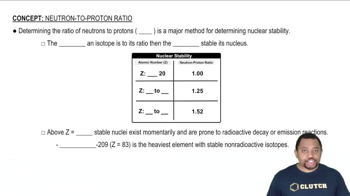
Neutron-Proton Ratio

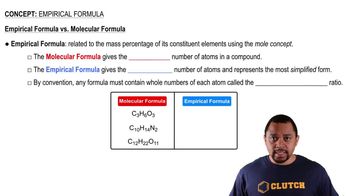
Empirical and Molecular Formulas

The empirical formula represents the simplest whole-number ratio of the elements in a compound, while the molecular formula shows the actual number of atoms of each element in a molecule. To find the molecular formula, one often starts with the empirical formula and uses the molar mass to determine the actual number of atoms. This distinction is important for accurately describing the composition of the compound in question.
Video consigliato:
Percorso guidato
02:26
Empirical vs Molecular Formula
Pratica correlata
Domanda del libro di testo

Epsom salts is a hydrated ionic compound with the following formula: MgSO4 • x H2O. A 4.93-g sample of Epsom salts is heated to drive off the water of hydration. The mass of the sample after complete dehydration is 2.41 g. Find the number of waters of hydration (x) in Epsom salts.

5197
views
Domanda del libro di testo

A hydrate of copper(II) chloride has the following formula: CuCl2 • x H2O. The water in a 3.41-g sample of the hydrate is driven off by heating. The remaining sample has a mass of 2.69 g. Find the number of waters of hydration (x) in the hydrate.

3683
views
Domanda del libro di testo

Find the total number of atoms in a sample of cocaine hydrochloride, C17H22ClNO4, of mass 23.5 mg.

1228
views
1
rank
Domanda del libro di testo

Estrone, which contains only carbon, hydrogen, and oxygen, is a female sexual hormone in the urine of pregnant women. Combustion analysis of a 1.893-g sample of estrone produces 5.545 g of CO2 and 1.388 g H2O. The molar mass of estrone is 270.36 g/mol. Find its molecular formula.

1481
views
1
rank
Domanda del libro di testo

Researchers obtained the following data from experiments to find the molecular formula of benzocaine, a local anesthetic, which contains only carbon, hydrogen, nitrogen, and oxygen. Complete combustion of a 3.54-g sample of benzocaine with excess O2 forms 8.49 g of CO2 and 2.14 g H2O. Another 2.35-g sample contains 0.199 g of N. The molar mass of benzocaine is 165 g/mol. Find the molar formula of benzocaine.

1229
views
1
rank
Domanda del libro di testo

Vanadium forms four different oxides in which the percent by mass of vanadium is, respectively, (a) 76%, (b) 68%, (c) 61%, and (d) 56%. Determine the formula and the name of each oxide.

1103
views