
Ch.3 - Molecules and Compounds
Tro - Chemistry: A Molecular Approach 6th Edition
Tro6th EditionChemistry: A Molecular ApproachISBN: 9780137832217Non è quello che usi tu?Cambia libro di testo
Capitolo 3, Problema 84

Copper(II) fluoride contains 37.42% F by mass. Calculate the mass of fluorine (in g) in 23.8 g of copper(II) fluoride.

Guida verificata passo dopo passo
1
Identify the percentage of fluorine in copper(II) fluoride, which is given as 37.42%.
Convert the percentage to a decimal by dividing by 100, resulting in 0.3742.
Multiply the decimal form of the percentage by the total mass of copper(II) fluoride to find the mass of fluorine: 0.3742 * 23.8 g.
Set up the multiplication to calculate the mass of fluorine in grams.
Perform the multiplication to find the mass of fluorine in the given sample of copper(II) fluoride.

Risposta video verificata per un problema simile:

Questa soluzione video è stata consigliata dai nostri tutor come utile per risolvere questo problema.
Durata del video:
2m

Concetti chiave

Ecco i concetti essenziali che devi comprendere per rispondere correttamente alla domanda.

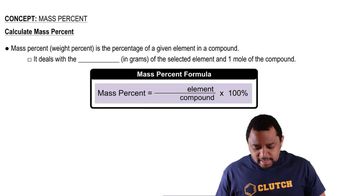
Mass Percent Composition

Mass percent composition is a way to express the concentration of an element in a compound, calculated as the mass of the element divided by the total mass of the compound, multiplied by 100. In this case, knowing that copper(II) fluoride contains 37.42% fluorine by mass allows us to determine how much of a given mass of the compound is due to fluorine.
Video consigliato:
Percorso guidato
00:38
Mass Percent Calculation

Calculating Mass from Percent Composition

To find the mass of an element in a compound using its percent composition, you multiply the total mass of the compound by the mass percent (expressed as a decimal). For example, if you have 23.8 g of copper(II) fluoride, you would calculate the mass of fluorine by taking 23.8 g and multiplying it by 0.3742 (the decimal form of 37.42%).
Video consigliato:
Percorso guidato
00:38
Mass Percent Calculation

Unit Conversion

Unit conversion is essential in chemistry for ensuring that measurements are in the correct units for calculations. In this context, while the mass of copper(II) fluoride is given in grams, understanding how to convert between different units (if necessary) is crucial for accurate calculations, especially when dealing with larger or smaller quantities.
Video consigliato:
Percorso guidato
01:56
Conversion Factors
Pratica correlata
Domanda del libro di testo

Most fertilizers consist of nitrogen-containing compounds such as NH3, CO(NH2)2, NH4NO3, and (NH4)2SO4. Plants use the nitrogen content in these compounds for protein synthesis. Calculate the mass percent composition of nitrogen in CO(NH2)2.

1368
views
Domanda del libro di testo

Iron in the earth is in the form of iron ore. Common ores include Fe2O3 (hematite), Fe3O4 (magnetite), and FeCO3 (siderite). Calculate the mass percent composition of iron for each of these iron ores. Which ore has the highest iron content?

1469
views
Domanda del libro di testo

The iodide ion is a dietary mineral essential to good nutrition. In countries where potassium iodide is added to salt, iodine deficiency (or goiter) has been almost completely eliminated. The recommended daily allowance (RDA) for iodine is 150 mg/day. How much potassium iodide (76.45% I) should you consume if you want to meet the RDA?

1365
views
Domanda del libro di testo

Write a ratio showing the relationship between the molar amounts of each element for each compound. (See Appendix IIA for color codes.) (a)

577
views
Domanda del libro di testo

The American Dental Association recommends that an adult female should consume 3.0 mg of fluoride (F-) per day to prevent tooth decay. If the fluoride is consumed in the form of sodium fluoride (45.24% F), what amount of sodium fluoride contains the recommended amount of fluoride?

1423
views
Domanda del libro di testo

Silver chloride, often used in silver plating, contains 75.27% Ag by mass. Calculate the mass of silver chloride required to plate 123 mg of pure silver.